
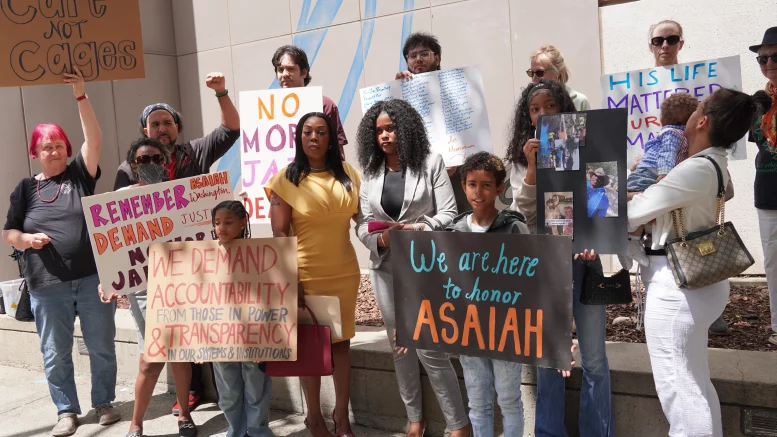
A rally at the Sacramento County Main Jail demands increased transparency and systemic health care reforms following a series of custody deaths.
Family members, community organizers, and civil rights advocates gathered May 28 outside the Sacramento County Main Jail to demand institutional accountability, increased transparency, and systemic health care reforms following a series of custody deaths.
The peaceful rally, held on what would have been the 42nd birthday of former inmate Asaiah Germone Washington, focused on allegations of medical neglect and systemic failures within the county jail system.
Organized by local advocacy groups, including Decarcerate Sacramento and the Anti-Police Terror Project, the demonstration brought together families of those who have died in custody.
Speakers at the rally called on the Sacramento County Sheriff’s Office to address what they described as a persistent pattern of neglect, particularly regarding the gatekeeping of medical care and mental health services for vulnerable detainees. The event occurred amid ongoing federal oversight of the county’s jail facilities and a contentious multimillion dollar jail expansion proposal.
Washington, 40, died July 26, 2024, while in custody at the Sacramento County Main Jail. According to the Sheriff’s Office, Washington and his cellmate were found unresponsive in their cell. Deputies administered Narcan, an opioid overdose reversal medication, which successfully revived the cellmate, but not Washington. His death later was attributed to an accidental fentanyl overdose.
Before his detention, Washington lived at a halfway house and passed weekly drug tests as part of his court requirements. His family said he was taken into custody because the court did not receive one of his drug test results from the month before his death. Washington also suffered from severe depression and Type 2 diabetes, requiring regular psychiatric medication and insulin.
Following his death, Washington’s widow, Tonette Washington, retrieved his belongings from the jail. Among them were several written requests, known as kites, in which her husband repeatedly requested his prescribed medications and psychiatric treatment from jail staff.
Speaking at the rally, she expressed her devastating sense of loss and the chilling realization that her husband had spent his final days pleading for medical assistance.
She read from the notes her husband had kept, stating that he basically was begging for his medication. Washington said that if custody staff had done their jobs and provided the necessary care, her husband would be alive today.
The family’s concerns also extended to the classification and screening of inmates.
Washington noted that her husband’s cellmate, who purportedly was transferred from a hospital and allegedly smuggled the lethal drugs into the cell, should have been flagged by staff.
“He would not be gone had they left him by himself [in a one-person cell],” she said. “This person [Washington’s cellmate] should never have been in there with my husband.”
Federal civil rights litigation against Sacramento County
Asaiah Washington’ family has taken legal action. The estate of Asaiah Washington, with Tonette Washington and her daughter Jadah Washington, filed a civil rights lawsuit July 30 in the U.S. District Court for the Eastern District of California.
The suit names Sacramento County, the Sacramento County Department of Health Services, Public Health Officer Eric Sergienko, the Sacramento County Sheriff’s Office, and Sheriff Jim Cooper as defendants.
The lawsuit, managed by civil rights attorneys Mark Merin and Paul Masuhara, alleges deliberate indifference to serious medical needs, negligence, and wrongful death.
The plaintiffs argue that jail authorities failed to meet constitutional standards of care by denying Washington his prescribed life-sustaining insulin and mental health medications, despite his documented requests.
The defendants, represented by Carl L. Fessenden and Cruz Rocha of the firm Porter Scott, filed their formal answer to the amended complaint May 11, denying the allegations of liability.
Systemic jail conditions and rising custody deaths
The Washington family’s lawsuit is one of several recent civil actions alleging systemic medical neglect inside the jail.
“He’s not the only one. There’s others; they don’t care,” Washington said at the rally.
In 2024, a separate federal lawsuit was filed on behalf of the family of Norman Fisher Jr., a 47-year-old pretrial detainee who died May 27, 2023, of septic shock and kidney failure.
That lawsuit alleges Fisher and his cellmate repeatedly used the cell’s emergency intercom button to request medical aid over a 10-day period, but were reprimanded by deputies who told them his severe illness did not qualify as an emergency. Fisher’s condition was downplayed by medical staff as a common flu, and a medical assistant allegedly falsified records claiming Fisher refused a blood pressure check when he actually was too weak to stand.
The protest at the Main Jail occurred within a broader context of elevated mortality rates and critical findings by medical examiners and grand juries. Since January 2021, at least 41 people have died in the custody of the Sacramento County jail system, according to The Sacramento Bee.
During the demonstration outside the jail, Keyan Bliss, former chair of the Sacramento Police Department Accountability Committee, and other community members read aloud the names of the 62 individuals who Decarcerate Sacramento says have died in connection with the county’s lockups since 2018.
The recent death toll stands in sharp contrast to historical state records.
A report by the state auditor shows that from 2006-2020, 62 people died in custody at the Sacramento County Main Jail. Local advocates pointed out that the numbers compiled by Decarcerate Sacramento match that total over only eight years.
In 2024, Washington’s death marked the fifth custody fatality within three months. That cluster of deaths drew sharp criticism from the court-appointed monitoring team overseeing the jail under a federal consent decree.
Following those fatalities, class counsel from the Prison Law Office and the law office of Aaron J. Fischer wrote a letter to Cooper expressing grave concern over the response to people in need. The attorneys noted that video footage of recent deaths revealed what they described as a culture of callousness and apathy, with deputies processing individuals in extreme physical distress through standard booking protocols without seeking medical intervention.
Medical experts involved in the federal case also concluded that some of the deaths may have been preventable. They recommended that the Sheriff’s Office retrain patrolling deputies and jail staff to recognize the signs of serious medical and mental health conditions and understand the criteria for emergency hospital transfers.
The Mays Consent Decree and the debate over jail expansion
The ongoing litigation over conditions in the Sacramento County jails stems from the 2020 Mays Consent Decree. The decree settled a 2018 class-action lawsuit alleging that jail conditions failed to meet minimum constitutional and statutory standards under the U.S. Constitution and the Americans with Disabilities Act. The county was ordered to reform its medical and psychiatric care systems, reduce its reliance on solitary confinement, improve suicide prevention measures, and ensure ADA compliance.
The physical limitations of the Main Jail, a high-rise facility built in 1989, have remained a central point of dispute. County consultants and grand jury reports repeatedly have stated that compliance with the consent decree cannot be achieved without structural modifications.
A 2022-2023 Sacramento Grand Jury report questioning the delay for complying with the concent decree found that grand jurors personally observed an arrestee in a wheelchair who had difficulty entering the medical intake area during booking, that inmates at risk for suicide were being housed in cells without blind-spot protections as required by federal law, and that in 2021 at least 58 inmates in restrictive housing were identified as mentally ill.
The report warned that without more aggressive interim action, the county risked federal receivership — a court-ordered takeover that would strip local officials of control over the jail system.
In a July 2023 response to that grand jury report, Cooper acknowledged ongoing ADA and HIPAA violations at both the Main Jail and Rio Cosumnes Correctional Center, noting that both facilities were constructed before those federal laws were enacted. Cooper’s office stated it was working with the Department of General Services to identify deficiencies and develop cost estimates, and pledged to pursue innovative near-term solutions while longer-term construction projects move forward.
Cooper’s office rejected the grand jury’s recommendation to install temporary medical trailers in the Main Jail parking garage, calling it not feasible due to space constraints and concerns that trailers would obstruct bus transport of inmates and impede Fire Department emergency access. The response also noted that the cost of overtime and on-call staffing to escort inmates to outside medical facilities — which averaged five to six medical transport runs daily in 2022, with spikes as high as 15 in a single day — was projected to exceed $6 million for fiscal year 2022-23. The Sheriff’s Office said those transport demands reduce the number of deputies available inside the facility to escort inmates to on-site sick call, pill call, and medical appointments.
Notably absent from Cooper’s grand jury response was any reference to the kite system or cell intercom process — the mechanisms by which housed inmates initiate requests for medical care — despite those systems representing the first link in the chain between an inmate reporting a medical need and receiving treatment.
The Sacramento County Board of Supervisors, responding to the same grand jury report in August 2023 by unanimous 5-0 vote, agreed that new facilities are needed to achieve Mays Consent Decree compliance, and acknowledged that healthcare space at the Main Jail is inadequate for the demand, noting that approximately 63% of the jail population carries an active mental health diagnosis.
The board also agreed that the county had been slow to act, though it partially disputed the grand jury’s finding that the Sheriff’s Department and county had ignored key recommendations from court-mandated experts. The board noted it had approved 33 plans to reduce the average daily jail population by at least 600 and had allocated more than $45 million for fiscal year 2023-24 toward population reduction and Consent Decree compliance efforts.
The board declined to implement the recommendation to redirect funds from medical transport runs toward interim facility improvements, stating that internal audits had not identified a significant number of unnecessary send-outs. It also declined to rapidly construct 18 additional mental health treatment rooms by the grand jury’s December 2023 deadline, calling the timeline unreasonable, though it said staff would test a modular prototype room and assess its viability.
The grand jury report further documented severe staffing shortfalls, noting a 100% vacancy rate for registered dental assistants, a 44% vacancy rate for Licensed Vocational Nurses, and 35.7 vacant positions in the UC Davis mental health program including 16 mental health workers. Court consultants also found insufficient designated custody escorts to ensure inmates could access medical and mental health services, including medication administration — a finding that directly echoes the experience described by Tonette Washington on behalf of her late husband.
In response to the structural findings, the Sacramento County Board of Supervisors approved a proposal in December 2022 to construct a multi-story intake and mental health annex adjacent to the downtown jail, initially budgeted at $450 million. By August 2023, the board approved an updated cost estimate of $654 million, securing up to $925 million in bond debt to finance the project.
Cooper and county administrators support the annex, arguing that a modern, structurally compliant facility is necessary to provide safe, humane medical and psychiatric care to an incarcerated population in which approximately 63% of individuals have an active mental health diagnosis. Cooper has publicly argued that even with jail population reductions, the existing Main Jail cannot meet federal mandates, and that expanding jail facilities is the only alternative to releasing dangerous individuals.
Advocates and community organizers, however, strongly oppose the jail expansion, characterizing it as a costly and ineffective measure.
Christopher Carbajal, program coordinator for Decarcerate Sacramento, argued at the rally that building a new jail will not address the deep-seated culture of neglect and abuse within the sheriff’s department. Carbajal told The OBSERVER that the sheriff’s budget has steadily increased over the last decade with no structured accountability for custody deaths.
Carbajal, also a member of the county’s Public Safety and Justice Agency Advisory Committee, said it discussed the systemic abuses by the sheriff and his staff.
“We had to talk about their practices … where they become gatekeepers of people’s medical health and their mental health inside that jail,” Carbajal said. “A large portion of these individuals have died because of sheriff and staff neglect.”
Carbajal also criticized the county’s financial priorities, noting that the overwhelming majority of discretionary public funds go to the sheriff’s department rather than community resources.
He pointed out that while county crime rates have declined, incarceration rates have risen, challenging the narrative that jail expansion is driven by public safety needs.
Decarcerate Sacramento advocates for reducing the jail population and redirecting public funds toward community-based behavioral health clinics, supportive housing, and diversion programs.
“One of our goals is to make sure that people are taken care of, we want to make sure people are given proper medical attention, resources and opportunities to be healthy,” Carbajal said. “Whether that’s inside the cell or not.”
The Sacramento County Sheriff’s Office did not respond to requests for comment regarding the May 28 demonstration or the calls for systemic accountability.
Additionally, the Sheriff’s Office declined to answer questions about how individuals in custody are able to access medical care — from the moment they first report a concern to actually being seen by a provider — as well as where things currently stand regarding compliance with the Mays Consent Decree and what the path forward looks like.
This story was originally published in The Observer, and is republished here with permission.




Be the first to comment on "Rally at Sacramento County Main Jail demands accountability following custody deaths"