
Sacramento County OKs sheriff’s partnership with DHS-linked cartel task force, retroactively approving months of work and sparking fears over ties to immigration enforcement.
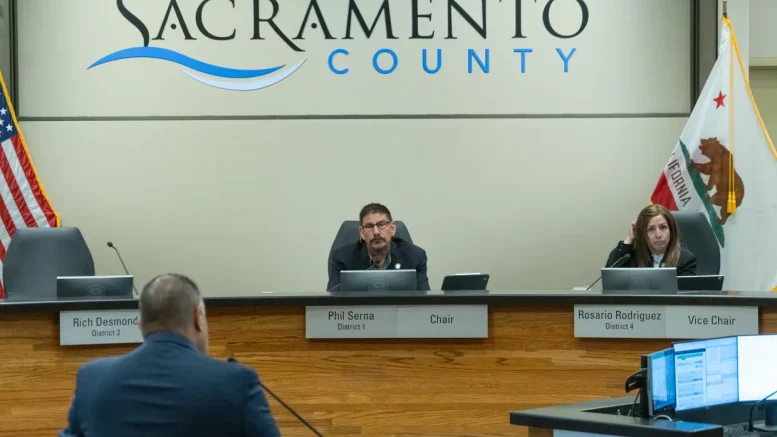
Sacramento County supervisors on May 12 approved a partnership between the Sheriff’s Office and a regional federal task force focused on international cartel activity involving guns, drugs and human trafficking.
The vote authorizes the Sheriff’s Office to officially join the Sacramento-San Francisco Homeland Security Task Force, a collaboration involving the FBI, the Drug Enforcement Administration, Homeland Security Investigations and the U.S. Attorney’s Office.
Homeland Security Investigations is a branch of U.S. Immigration and Customs Enforcement, though discussion during the meeting reflected disagreement and uncertainty over what role, if any, immigration enforcement would play in the task force’s local operations.
Although the vote took place in May, the agreement is retroactive and covers the period from Oct. 1 through Wednesday, Sept. 30. That means the Sheriff’s Office had been participating in the task force and incurring expenses for approximately seven months before the board formally approved the agreement.
The board’s action authorizes reimbursement for staff time, rent and other operational costs accumulated since the fall.
The partnership is intended to combat international cartel activity, including guns, drugs and human trafficking. Because these crimes often involve large networks operating across state and national borders, local law enforcement agencies frequently work alongside federal authorities to investigate and disrupt them.
Under California law, local law enforcement agencies may work with federal authorities on criminal investigations, including cases involving violent offenders, drug trafficking and organized crime. State sanctuary laws, however, limit the use of local resources for civil immigration enforcement.
By joining the task force, Sacramento County detectives will work directly with agents from the FBI, DEA and Homeland Security Investigations. The task force also includes attorneys from the U.S. Attorney’s Office who are responsible for prosecuting cases in federal court.
Supporters of the agreement said the partnership combines the Sheriff’s Office’s local knowledge with the federal government’s investigative resources, advanced technology and international reach to target sophisticated criminal organizations.
The agreement also serves as a financial arrangement between the county and the federal government. The FBI agreed to reimburse the county for costs associated with participating in the task force through what is known as a revenue agreement.
Under the agreement, the federal government will provide up to $500,000 to cover operational expenses, including office space and the salaries of Sheriff’s Office employees assigned to the task force. The funding is intended to help offset the additional staffing and equipment costs associated with complex federal investigations.
The agreement also contains a provision regarding asset seizure. Asset seizure occurs when law enforcement confiscates money, vehicles or property believed to have been used in a crime or purchased with proceeds from criminal activity. Under the agreement, the Sheriff’s Office will retain 5% of assets seized during task force investigations. Those funds then can be used for law enforcement purposes.
Before supervisors made their final decision, they heard testimony from several community members during the public hearing. Many speakers urged the board to reject the partnership, expressing concern that collaboration with agencies such as ICE — even in criminal investigations — could create fear within immigrant communities.
Speakers argued that if residents believe the Sheriff’s Office is working closely with immigration authorities, some community members may become reluctant to report crimes or seek help when in danger.
Christopher Camilo Carvajal, program and campaign coordinator for Decarcerate Sacramento and an appointed member of the Sacramento County Public Safety and Justice Agency Advisory Committee, told the board that when he was 6, he witnessed officers arrest and jail his father, Camilo, who later was deported to Mexico. He said the arrest “split my family in half” and forced his mother to become a single parent overnight. Carvajal said his father died after 20 years of forced separation without ever returning home.
“These collaborations destroy families, they destroy communities, and today that fear is rising across Sacramento communities,” Carvajal said during his testimony. He added that for families like his, these are not “abstract policies,” but life-altering experiences.
Carvajal also criticized the financial component of the agreement, specifically the county’s 5% share of seized assets.
“By formalizing this partnership, the board is choosing to prioritize federal surveillance and a five percent cut of seized assets over the safety and trust of our immigrant neighbors,” he said.
Carvajal further argued that while California sanctuary laws were intended to prevent local resources from being used for immigration enforcement, the task force maintains ties between local law enforcement and federal immigration agencies involved in deportations.
He also raised concerns about the retroactive approval process, stating, “We are deeply concerned that a retroactive agreement effectively validates months of unaccountable cooperation between the Sheriff’s Office and federal immigration investigators.”
The five supervisors were divided over the resolution, reflecting tension between securing federal funding for public safety efforts and maintaining trust with immigrant communities.
The three supervisors who voted in favor — Rosario Rodriguez, Rich Desmond and Pat Hume — emphasized the practical benefits of the partnership. They argued that international cartels contribute to the flow of dangerous drugs and weapons into Sacramento and that the Sheriff’s Office needs the FBI funding to help cover the high costs of combating those crimes.
Supporters of the agreement maintained that, as long as the task force remains focused on major criminal activity such as human trafficking and drug trafficking, the partnership represents a responsible approach to public safety that remains consistent with state law.
Supervisors Phil Serna and Patrick Kennedy cast the two dissenting votes. Their concerns focused on both the timing of the agreement and the involvement of federal immigration agencies.
Serna questioned why the Sheriff’s Office had been participating in the task force since October without prior authorization from the board. Kennedy expressed concern that the involvement of agencies associated with immigration enforcement, regardless of the task force’s stated mission, could damage trust between law enforcement and Sacramento residents.
The decision authorizes the sheriff, or a designated representative, to sign the agreements and take all necessary actions to implement the partnership.
With the board’s approval, the county now can collect federal reimbursements and its 5% share of seized assets for work performed through September. The agreement remains in effect unless one of the participating agencies withdraws.
This story was originally published in The Observer.




Be the first to comment on "Sac County approves Sheriff’s alliance with DHS, ICE-linked task force"