
By Scott Thomas Anderson
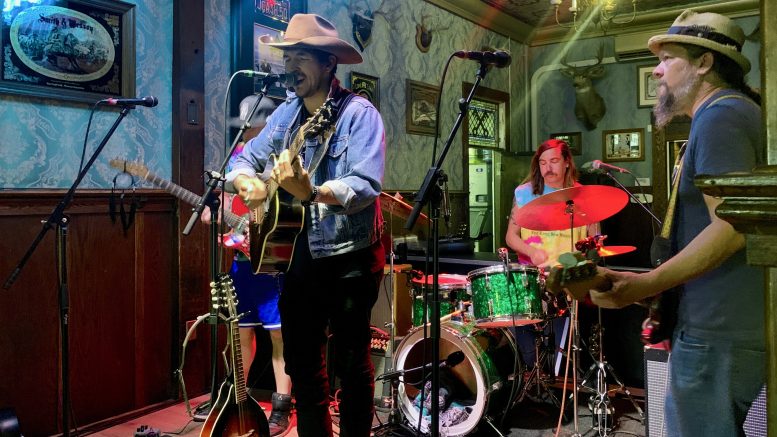
Texas birthed some titans of that restless renegade sound that defines Outlaw Country, but last Friday night, when one of the Lone Star State’s new musical mavericks arrived in Folsom, it wasn’t Willie Nelson or Waylon Jennings he stopped to ruminate on, it was a poetic prophet of the damned associated with the city’s old prison walls.
Dallas Burrow was thinking about Johnny Cash.
That’s partly because Burrow, a songwriter from New Braunfels, understands Cash’s battered and unlikely redemption arch. Like Cash, Burrow had an untamable streak in his younger days behind the microphone. He played his six-string hard, but lived even harder. He was on a white-knuckle ride through smoky saloon life that had already ended in disaster for some of his heroes, particularly Texas’s stirring, finger-picking balladist, Townes Van Zandt, who was blood brothers with Burrow’s father.
“What happened to Townes is tragic,” Burrow observed, glancing down Sutter Street. “He represents the artist I want to be, but not the life I want to live.”
But Cash was a wayward performer who avoided that fate. So has Burrow. Similar to Cash, a spiritual journey eventually brought him to a healthier place in life — and a place where his lyricism and musical innovations found more muscle than they’d ever had.
And that’s what the audience at the Folsom Hotel was about to hear for themselves.
Burrow’s upcoming album The Way the West Was Won is a return to the sharper and grittier side of western sensibilities. There’s no pop veneer or auto-tune sanitation to these songs. There’s no record exec’s wet dream for product placement or cross-over sponsorships. These are straight-up explorations of the rural identity — rough times, rough riding and rough shadow-wrestling with one’s conscience.
The album is unapologetically steeped in tradition.
That’s clear from one of the first singles to drop, “Read ‘Em and Weep,” a rollicking knife-fight of a song with slide work and fiddle flare that cuts through a gambling man’s credo. That number is a duet with central Texas songwriter Ray Wylie Hubbard, who, like Van Zandt, had a huge influence on Burrow’s trajectory.
“When I was about 14-years-old, I was at Gruene Hall for an Americana jam that the local radio station puts on, and I can remember seeing Ray Wylie Hubbard playing in the middle of the afternoon to a sold-out crowd,” Burrow recalled. “And he was up there just doing his funky thing; and there was sort of this epiphany of a moment when I realized a guy with a guitar could do what he was doing.”
Burrow has stellar performers jumping in from one side of his new album to the other. That’s what makes compositions like “Black Rock Desert Blues” shine. That track is an acoustic gallop through the sun, with Burrow’s meditative words strengthened by a steer-stomping bass line and haunting accordion runs. Another tune, “Tornado” — a ballad that one could easily imagine Johnny Cash covering — brings an intriguing story to life through some flamenco heat and the ring of Latin trumpets.
“He’s an excellent writer and he speaks from the heart,” said Andy Mattern, a harmonica player who drove to Folsom from Ukiah to hear Burrow play. “Listen to his words. I’ve been watching him grow and change. It’s beautiful.”
Before Burrow taking the stage in Folsom, he was asked about ‘the Man in Black.’
“I feel a kinship to the spirit of who he was as a man and as an artist,” Burrows explained, noting that he was recently filming a scene for a documentary on Waylon Jennings with his friend, country singer Charley Crockett, when they unexpectedly found themselves starring at a jacket that Cash had owned, which is on display in a makeshift museum in the back of a liquor store and gas station in Littlefield, Texas.
“It was this black coat with the colorful Native stitching on it,” Burrow remembered.
He and Crockett asked the owner of the artifact, Waylon Jennings’ brother, if they could take a picture in front of it.
Burrow was told that, if he wanted, he could try it on.
“It fit me like a glove — it was perfect,” he recounted with a smile. “I would say the universe rung like a bell for me when I put on Johnny Cash’s coat.”
He added, “For me, that was like pulling Excalibur from the stone.”
‘The Way the West Was Won’ releases on September 26 on Apple Music and other platforms. Click here for more info on the album.




Be the first to comment on "Guitars and reflections: Dallas Burrow’s show in Folsom touched on city’s music legacy, previewed intrepid new album ‘The Way the West Was Won’"