
Despite a decline in reported crime, Sacramento’s police budget has doubled over the past decade, while the number of sworn officer positions has decreased.
At a recent City Council meeting, several members of the public said the loss of mounted police officers would compromise public safety, reflecting ongoing support for maintaining or increasing police funding.
An analysis of Sacramento police staffing, spending and crime data over the last decade shows rising police expenditures alongside lower officer staffing and a decline in reported crime.
With Sacramento facing a projected $66 million budget deficit, city leaders are preparing to finalize a proposed $255.7 million budget for the Sacramento Police Department. That continues a multiyear increase in police spending even as sworn officer positions have declined.
City records show Sacramento’s police budget has grown from roughly $125 million in fiscal 2015-16 to more than $253.6 million today, an increase of approximately 102%. During the same period, authorized sworn officer positions declined from 740 to 699.
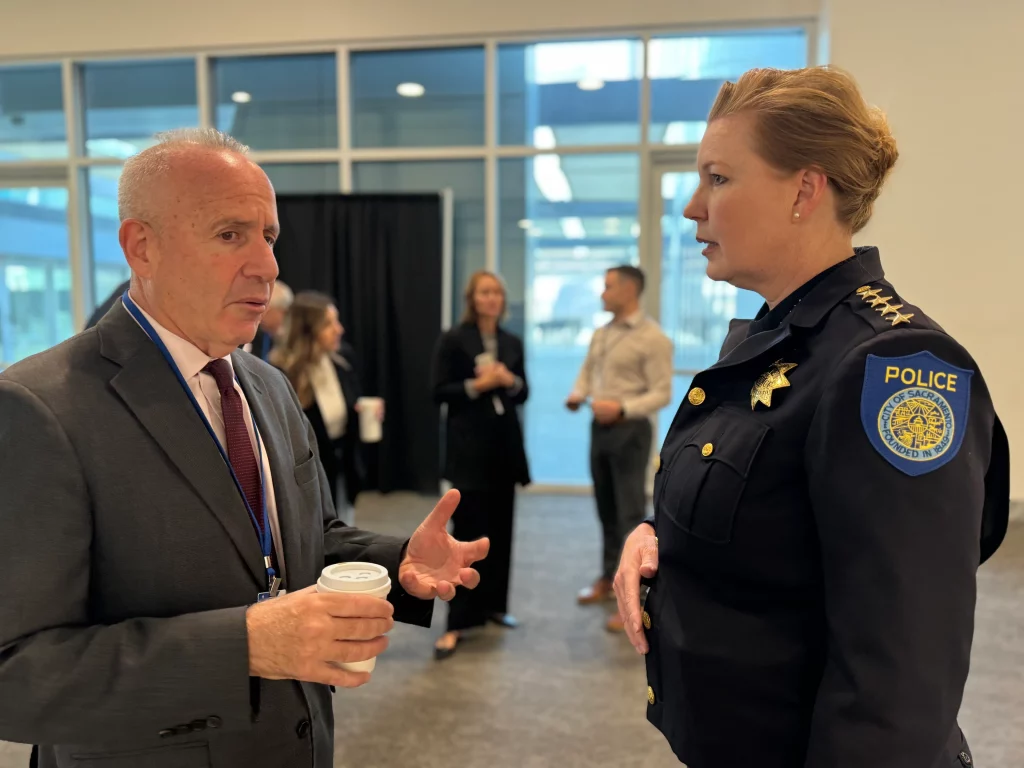
Darrell Steinberg, left, Sacramento’s mayor from 2016-2024, with recently retired Sacramento Police Chief Kathy Lester. The police budget doubled from roughly $125 million in 2016 to nearly $255 million in 2025. Photo by Robert J. Hansen.
Despite fewer sworn officers, Sacramento is reporting lower levels of crime relative to population and staffing levels than a decade ago, creating what can be described as a “safety paradox.”
Crime data shows reported crimes per 1,000 residents declined from 37.9 in 2016 to 29.1 in 2025, or roughly 23%.
Sacramento’s crime trends over the past five years have followed national patterns during and after the COVID-19 pandemic.
Violent crime increased in 2020 and 2021 before declining in later years. Sacramento recorded 43 homicides in 2018 and 56 homicides in 2021. By 2025, that had fallen to 42 homicides.
National data from the FBI and crime analysts shows a decline in violent crime and homicide rates between 2023 and 2025, following increases during the pandemic period.
The Atlantic reported that many large police departments entered 2025 with fewer officers than before the pandemic while violent crime declined nationally.
Cities including Philadelphia, Seattle and New Orleans also reported declines in homicides during this period while operating with reduced staffing.
Law enforcement officials attribute declines in crime to policing strategies, including focused enforcement operations, investigative units, surveillance technology and intelligence-led deployment.
Police also have pointed to increased costs related to salaries, pensions, overtime and technology as factors driving budget growth, even without major increases in staffing.
Public health researchers and violence prevention organizations cite community-based intervention programs as contributing factors in violence reduction.
Organizations including Advance Peace Sacramento and Voice of the Youth expanded programs following the pandemic using federal recovery funding.
These programs use “credible messengers” to engage individuals identified as being at higher risk of involvement in violence. Services include mediation, mentorship, case management and intervention in ongoing conflicts.
The Sacramento Office of Violence Prevention coordinates some of those such efforts alongside community-based organizations, schools and health systems.
The City of Sacramento has received a $5 million state grant through the California Violence Intervention and Prevention program, administered by the California Board of State and Community Corrections.
The funding is intended to expand violence prevention and intervention programs in neighborhoods most impacted by gun violence.
Sacramento was one of four large cities selected for the maximum award in the latest funding cycle. The grant will support programs coordinated by the Sacramento Office of Violence Prevention, which operates within the Police Department.
Dr. Nicole Clavo, who directs the office, stated in an email that the office focuses on preventing violence before it occurs through outreach and coordination with community partners.
Programs include rapid response after shootings, outreach from community messengers, youth mentorship, case management and trauma-informed services for victims and families.
Clavo said the grant will support expansion of outreach, case management, mentorship, victim services and program evaluation. The structure for distribution of funds to community organizations has not been fully detailed publicly.
While overall homicide totals have declined, gun violence in Sacramento continues to disproportionately affect Black residents.
Black residents make up approximately 12.6% of Sacramento County’s population and accounted for about 52% of gun-related deaths between 2019 and 2023, according to previous OBSERVER reporting.
Of 381 gun-related homicides in that period, 197 victims were Black.
National research has linked reductions in violence in recent years to a combination of factors, including post-pandemic federal funding for local programs.
The American Rescue Plan Act directed federal funds toward violence prevention, youth employment, mental health services and housing stabilization programs in many cities.
Researchers at the University of Chicago’s NORC Center on Public Safety and Justice, cited in The Atlantic, have identified such investments as one factor under study in national crime declines.
Sacramento’s upcoming budget decisions will determine next year’s funding levels for policing and violence prevention programs as federal recovery funds decrease.
City officials continue to discuss how to allocate resources across policing, prevention programs and other public services as part of the broader budget process. Final adoption of the budget is expected June 9.
This story was originally published in The Observer, republished here with permission.





Be the first to comment on "Sacramento’s police budget soars as crime rates, staffing fall"