
Court records confirm that iconic bar was lost to drugs, arson and Fear and Loathing in the Delta
By Scott Thomas Anderson
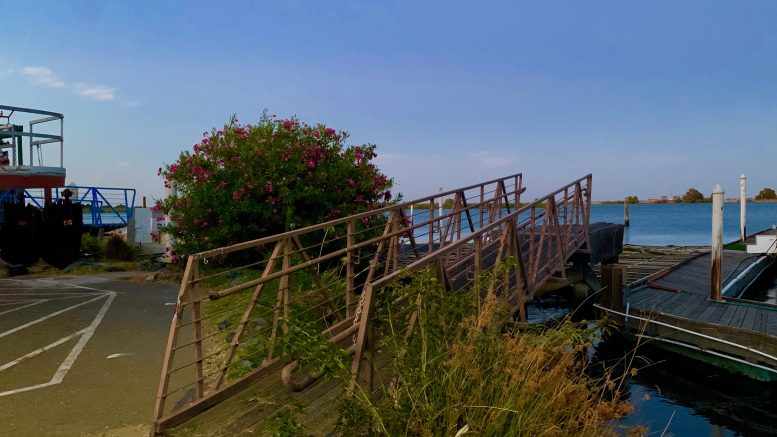
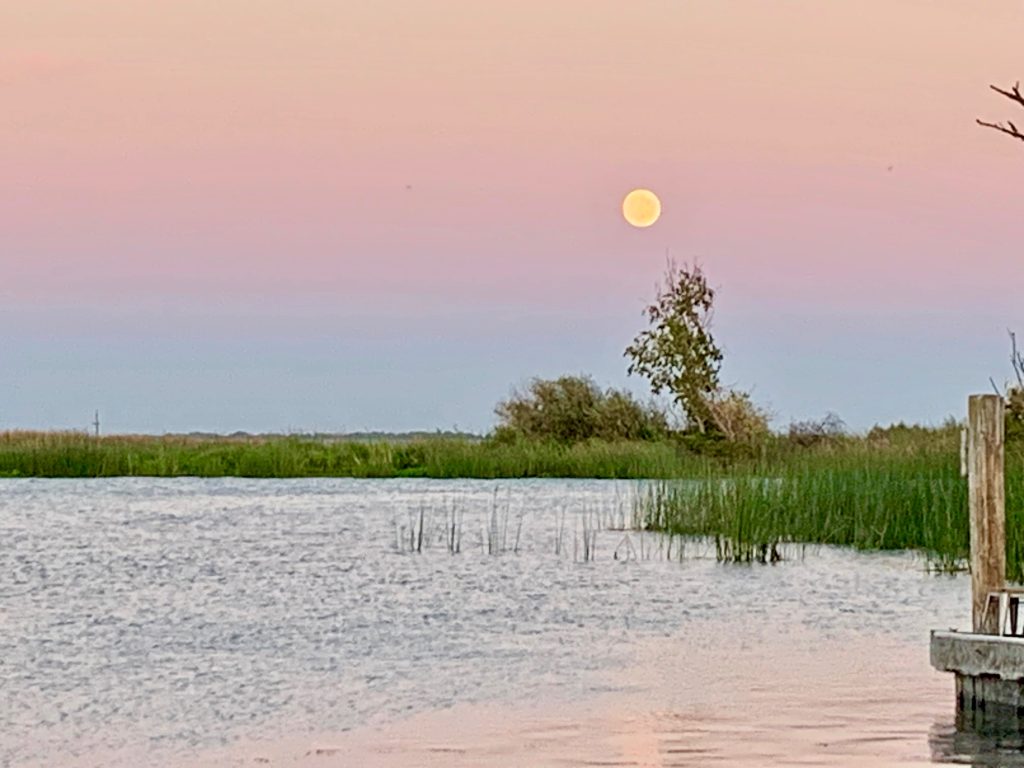
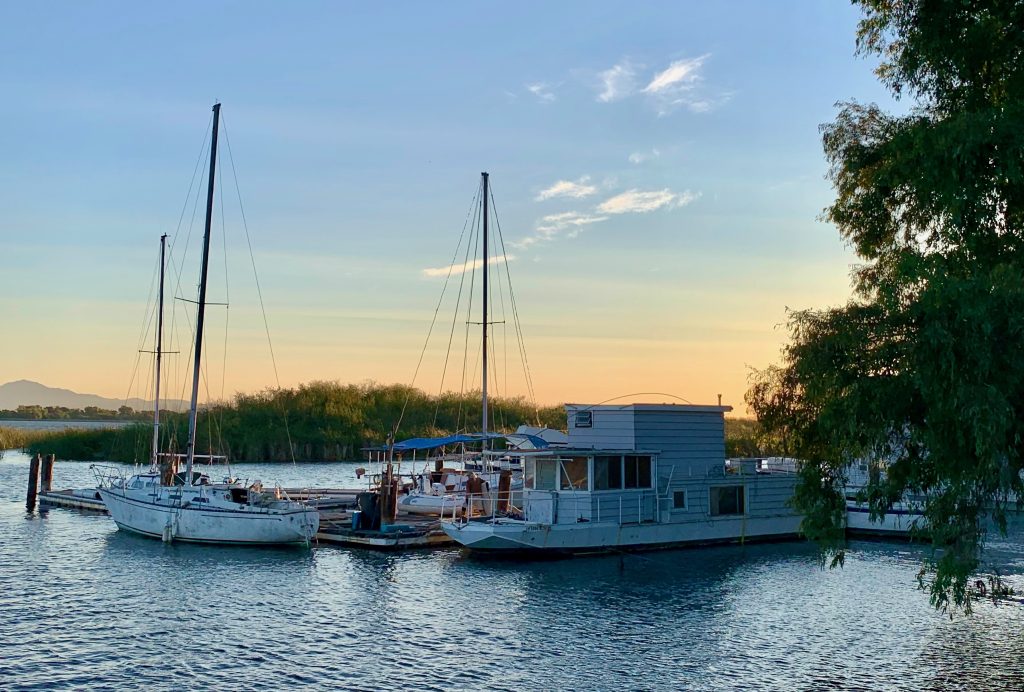
Tonight, even with the moon rising over a tangle of willow branches and high coif of bulrush, there are still great egrets diving down on the river, their white forms gliding across that long gleam of the tide off Brannan Island. They’re the only movement at a lonely ghost marina just north of where the Mokelumne River and San Joaquin River collide. Down the road a little, at the next harbor over, a live band is performing against the breezy Saturday sundown. But there’s no reveling here where the egrets are swooping for fish in the twilight. In this desolate marina, there’s only a lone yacht anchored next to the remnants of a scorched, curled dock to nowhere – and a battered steal ribcage touching the waterline.
Those are all that remain of Moore’s Riverboat Restaurant and Bar.
Yet if one stands long enough near the metal bones half-sunk in the current, you can almost hear the echo of everyone who laughed and made memories here for generations.
Moore’s Riverboat had been a stalwart of Delta culture, one of those quirky enclaves that make people fall in love with a sense of being lost in California’s meandering river world. Along with the estuary’s other famed drinking dens – Wimpy’s, Al the Wop’s, Foster’s Bighorn and the late Giusti’s – Moore’s Riverboat featured a distinct look and feel that was all its own. It was a hideout for watching waves, feeling channel breezes and admiring the sun falling on the tree-pocked cuts and sloughs. Plenty of fans remember pulling houseboats along Moore’s dock for lunch, or catching the sight of Bloody Marys and buckets of crawfish, or letting kids feed French fries to the big carp and stripers in the water. There were times when live musicians performed on the boat’s bow. It wasn’t unheard of for sailors to put on sunglasses and pretend to be blind so they could get their dogs in.
And, of course – “the panties.”
Everyone remembers the panties.
Or, to be more specific, most Delta dwellers remember an era of the restaurant when countless and often giant women’s panties were hung from its ceiling.
“It was just about everybody’s favorite place,” said Bill Wells, Executive Director of California Delta Chambers & Visitor’s Bureau and author of the Delta Rat Scrapbook. “It was the natural ambiance of the place. Part of it was being right on the river so you could see the boats go by. Originally, the harbor there was deep enough that you could get a bunch of boats in there.”
Wells has been sailing on the Delta for nearly 40 years. He stresses that, like all the beloved hangouts tucked along the water from Clarksburg to Rio Vista, Moore’s Riverboat was embraced for its eccentricities.
“You know, sometimes I’d be at a club somewhere, and some woman would be talking and say, ‘Oh yeah, my panties are up on the roof of Moore’s Riverboat,” Wells remembered. “It was hilarious.”
On the afternoon before it all ended, July 5, 2022, regulars of the place were still lounging with Coronas on its deck, looking out at flat clouds and blue skies spanning over the Mokelumne. It wouldn’t last. In a matter of hours, alleged chemical-churning confusion and manic dread would cause this piece of floating history to go up in flames.
The main perpetrator responsible for the destruction pleaded guilty to felony arson in February of last year. His decision to dodge a trial meant that a jury will never hear testimony about the mischief and motives that ended Moore’s Riverboat. However, the official investigation into that bizarre night on the riverways is now part of the court record, and it illuminates a tale of senseless loss during a frenzied night of reported drug trips.
The men in the shadows
The Delta community was already experiencing a rocky few years before the arson on Brannan Island. One of its noted winemakers, Duke Heringer of Twisted River, had vanished without a trace in October of 2018. Ten months later, several meth-addicted identity thieves from Antioch lured their friend, Fabian Costila, out to the Bailey Ranch on Andrus Island and then doused him with gasoline before burning him alive. SN&R covered the full story of that saga in “Blood and Fire.” Then, in September of 2021, an accidental blaze at the end of Snodgrass Slough leveled Giusti’s Place, one of the Delta’s true culture-bearing restaurants that was housed in a century-old trading post and ferry tavern. That marked the end of a key destination for visitors who were ‘in the know.’ And all of these grim events were highlighted between a series of ongoing news stories about Gov. Gavin Newsom continuing to try to build his controversial $20 billion Delta Tunnel, which independent experts believe will lay waste to family farms, small businesses and historic sites across the Delta, not to mention killing off its fragile wild salmon population.
By July of 2022, people who value the area were looking for a break in the bleakness.
But two nights after Independence Day, it was clear that wouldn’t happen when a 911 call went out at 3 a.m.
Firefighters launched their engines from a station in the fields behind Isleton, racing down Highway 12 and turning onto a serpentine road flanked by corn fields and the black, lapping waves of the Mokelumne River. The responders rolled by the Delta Shores Resort, then the Lighthouse Grill, before arriving at the spectacle of Moore’s Riverboat fully engulfed in fire. They could see flames that were extending 20-to-30 feet above its roofline.
“Essentially, the structure was a boat,” recalled Paul Cutino, Chief of the River Delta Fire District, “so everything on from the floor down was under water, and it was unsafe to send firefighters in. So, I deemed it unsafe and we went into defensive mode to protect exposures.”
Cutino, who’s also a sworn peace officer, said that while testifying at a preliminary hearing in Sacramento Superior Court in March of 2023.
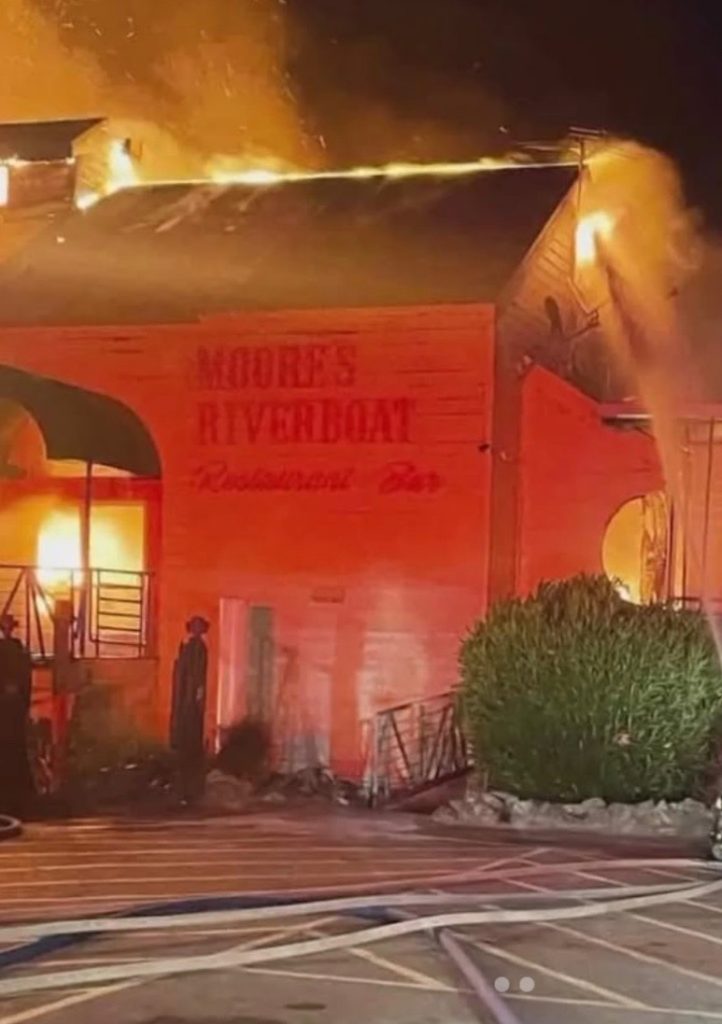
Moore’s Riverboat is not an easy structure to describe – in court documents or a news article. When it originally opened on Brannan Island in 1966, the restaurant was housed in a classic riverboat called The Sutter, which dated back to the time as Sacramento’s Delta King. Back then, The Sutter was owned by a captain named John Moore. It was he who ruled over the era of the hanging panties. Ironically, in 1993, a fire broke out in boat’s galley and caused heavy damage. This first iteration of Moore’s Riverboat was hauled off, repaired, and eventually became the headquarters of the San Joaquin Yacht Club where it’s now docked off Bethel Island. The owners of Moore’s at the time, Ken and Elvera Scheidegger, then purchased the empty barge-restaurant called the Catfish Café that was on the Deep Water Channel. They moved it to Brannon Island to serve as the new incarnation of their business. A huge part of the resurrected Moore’s Riverboat was designed to look like an old school Broward yacht, complete with a sundeck and bow for relaxing on – and that’s what was swallowed by fire when the cavalry arrived.
Chief Cutino noticed the inferno was “progressing with intensity.” It didn’t seem to Cutino that this was just a matter of wood burning. He thought an accelerant was involved.
As the once mighty Moore’s was smoldering into an ash heap, some charred boards from its docks were floating on the water. Cutino made sure those pieces of the structure were booked into evidence. Lab testing would eventually confirm his suspicions about the presence of chemicals. Cutino was soon investigating the cause by going through hours of surveillance video. And the restaurant’s cameras did indeed capture a shadowy figure pouring an ignitable liquid on the boat’s dock. The overall footage was dark, but Cutino could make out two men moving around the area. One of them was clearly the main arsonist. Cutino watched that individual walk out to where the gasoline had been spread around with “an item that was burning” and then bend over to spark the disaster. Stepping away, the obscured fire-starter noticed that his initial flames were dying down, so he came back to the stop to re-ignite them.
Cutino also caught sight of a Jeep coming out of the darkness as the flames began spreading.
The morning after the fire, boaters on the Delta saw a collapsed, smoking ruin that was all but unrecognizable.
“I was shocked,” Wells acknowledged. “It was really unfortunate. It had just been the natural place for everyone to go. The news was around the Delta in about a day – that it had been destroyed.”
The Byrd is the Word
Rafael Martinez, the manager of Moore’s Riverboat, and Mary Machado, one of its waitresses, were both interviewed by fire investigators about the restaurant’s last hours. From them, Cutino learned that several men had been in the back, drinking beers and playing darts. Eyewitnesses initially identified one of them only as “Shroom.” But another was someone that the staff could easily name – Brian Byrd.
He was a regular at the place.
Byrd had arrived that night on a motorcycle with his friend Daniel Carusco.
What Machado and Martinez remembered was Byrd trying to get out of paying his tab. Machado described watching Byrd hold his wallet out, thumb through a wad of visible cash, but never go through with actually paying.
“She said he was staring off in the distance, that he had a gaze as if he really didn’t know where he was at the moment,” Cutino testified, adding that the waitress eventually watched Byrd head outside.
Byrd was then seen struggling to start his motorcycle.
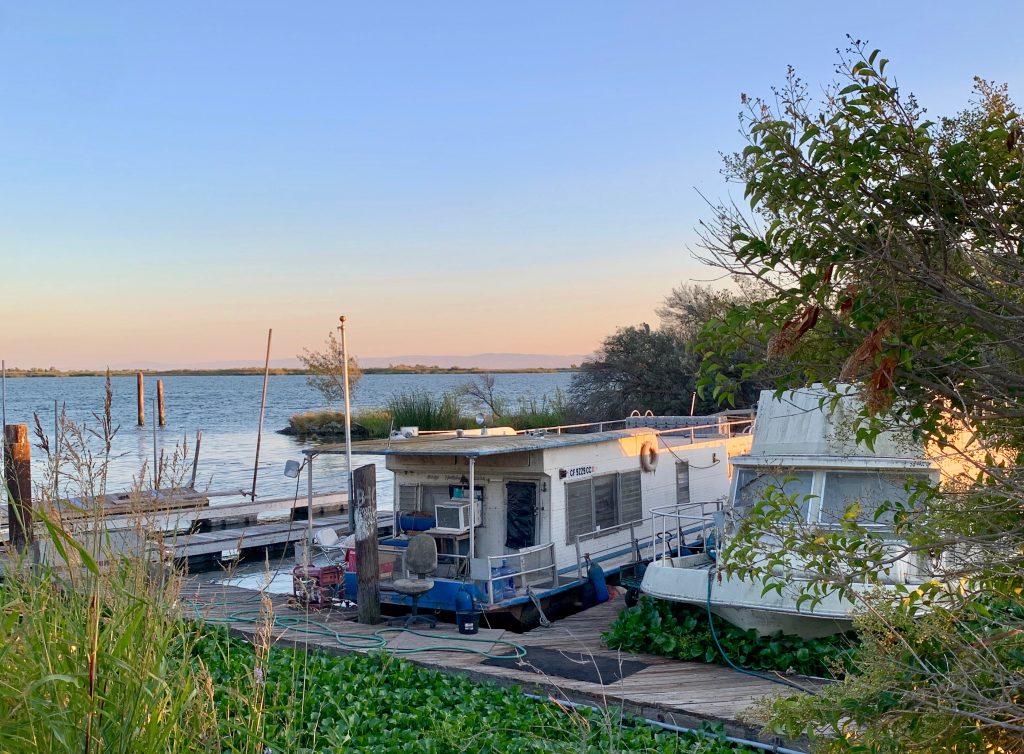
One thing that Cutino wanted to know was who owned the Jeep that had gone driving through the crime scene during the arson’s apex. Searching for leads, he brought the surveillance footage to Tom Tate, the Harbor Master at Pirate’s Lair, a marina just south of Moore’s. Tate recognized the Jeep as belonging to a local named Wyatt Tripp. Court records indicate that Tripp lived in a Brannan Island trailer park down a levee from the Spindrift Marina. That’s a spot flagged by a weathered bar and flashing bulb-pointers ahead of yacht sheds and some ancient-looking houseboats.
Prosecutors also noted in court documents that Tripp has prior criminal convictions for illegal possession of a gun and illegal possession of ammunition.
Soon, Gershom Slonim, an investigator for the State Fire Marshall, was confronting Tripp.
During their conversation, Tripp said he’d been out near the crime scene that night for his own reasons.
“He was going to sort through the trash, because he collects things, and there’s trash bins in front of Moore’s Riverboat,” Slonim later testified. “He parked his Jeep there. He said he got out and walked on the dock and saw the defendant, [Brian] Byrd … Mr. Tripp said that when he went around the corner, he saw what he thought was a bonfire and Mr. Byrd.”
“Did he say what Mr. Byrd said as he approached?” asked Sacramento Deputy District Attorney Vanessa Washington.
“He said, ‘Wyatt, dude, you got to get me out of here,’” Slonim recounted. “And Tripp said he didn’t want to get caught on camera because of the fire, so he left the area, came back, and gave Mr. Byrd a ride away from the scene.”
Tripp told Slonim that he wasn’t really friends with Byrd, more of an acquaintance. Nevertheless, he helped Byrd fly the coop.
A knock in the night
It was 4 a.m. when Brannan Island resident Mike Lee heard banging outside his house. It was Brian Byrd. The running man knew Lee from having previously done work for him. Now, Byrd was telling Lee he’d “done something bad.”
Byrd ended up falling asleep on an outside couch in Lee’s garden.
Around 6 a.m., Lee noticed a Toyota Corolla pull to a stop up on the levee. A woman got out and started calling, “Brian! Brian! Where are you?!”
Lee watched Byrd rouse himself, eventually joining the woman as they took off for destinations unknown.
A little bit later, while Cutino was still inspecting Moore’s smoldering ruins with Battalion Chief Chris McPeak, Lee appeared to hand the firemen a black bag. Inside was a small lighter and some mail addressed to Brian Byrd.
“Michael Lee proceeded to tell us that Byrd came to his house and said, ‘I did something bad, I started a fire at Moore’s Riverboat,’” Cutino explained on the stand, adding that Byrd had begun pleading with Lee, “Someone is going to try to kill me … take me off the island – just get me off the island.”
Court records also show Lee told authorities that Byrd mentioned having “smoked mushrooms” on the night of the crime.
Another witness named Edna Cole was later interviewed by a defense investigator, saying, “Brian told me that he was high” when it happened, “on mushrooms,” and that he “tried to light an M-80 but didn’t have a lighter.”
A separate trial brief filed in the case asserts that, “defendant [Byrd] had been at the restaurant on the night of the fire for most of the evening, socializing and consuming a quantity of psychedelic mushrooms … Defendant thereafter started experiencing acute paranoia. He increasingly believed a group of men, possibly including Tripp and Carusco, were trying to kill him. Defendant heard voices that were taunting him and warning him that he would not make it off the island alive.”

Drug culture has long-plagued the central Delta. In 2016, SN&R relayed a tale that was circulating at the time through Isleton, the nearest town to Brannan Island, which involved locals getting so fed up with crime associated with a rundown trailer parked in front of a meth house there, that one resident decided to go rogue by hooking the offending unit up to his truck in the middle of the night. The way this anecdote is remembered, the vigilante then burned rubber for Jackson Slough as the terrified devotees of tweakery started jumping from the trailer for their lives. And the outpost where the original Moore’s Riverboat was towed to, Bethel Island, experienced so much drug activity in the late 2000s that it was referred to, for a time, as “Methel Island.” But neither of those places had iconic destinations burned to the ground by users. At least, not in recent memory. The obliteration of Moore’s Riverboat has had lasting consequences.
Byrd and Tripp were both initially arrested, though prosecutors ultimately moved the entire culpability to Byrd.
On February 6, 2024, Byrd pleaded guilty to felony arson. He was sentenced to two years in state prison with the stipulation that he’ll have a life-long registration in California as an arsonist.
Meanwhile, as Delta communities continue to battle the Newsom Administration for their future, the estuary’s ever-threatened fishing and recreation economy has one less engine firing for tourism after the loss of Moore’s Riverboat.
“Every restaurant is very important here,” Wells observed. “Nobody is going to come to the Delta if there’s only one place to eat. We need every one of them to help the overall economy.”
Scott Thomas Anderson is also the writer and producer of the true crime podcast series “Trace of the Devastation.”

Interesting article.