
By Ken Magri
In the immediate aftermath of Proposition 50’s passage, also known as the Election Rigging Response Act, Assemblyman James Gallagher submitted what he called a “two-state solution” to split California in half.
Officially named Assembly Resolution 23, Gallagher’s plan proposes to begin a process of dividing the state vertically into a western coastal section and an eastern inland section.
By introducing the resolution, Gallagher referenced Proposition 50 to elaborate on what he sees as inherent unfairness within California’s current elected government. The assemblyman maintains that urban populations in cities along the coast are vastly over-represented when compared to the state’s more rural counties.
“They exploit our water, suppress our energy, skyrocket our costs and kill our jobs,” Gallagher claimed in a statement about his resolution. “I have come to see that the only way we can obtain proper attention is by pursuing our own statehood. With this measure, we will begin the first steps of that progress.”
He concluded, paraphrasing Moses’ appeal to Pharaoh in the Bible, “Gavin, let my people go.”
If passed, this joint resolution is not a bill that would become law, but an expression of the legislature’s opinion about a matter within the jurisdiction of the federal government. To successfully divide any state, its legislature, the US Congress and the current president would all have to be in favor of a specific bill doing such.
But currently, no such bill would pass in California’s Democrat-dominated assembly or state senate, so Gallagher’s gambit was introduced simply as a resolution.
Asked by SN&R if his effort was sincere or more of a protest against Prop. 50, Gallagher answered, “It’s both.”
“I am protesting the extreme injustice of Prop. 50 and starting the process for statehood,” he added. “This [Prop. 50] is a measure where maps were drawn by politicians with no public transparency, against the will of the voters and the expressed terms of our constitution, and pushed to the ballot on an expedited time frame with only three days of legislative notice.”
Governor Newsom’s office responded on his X account by saying, “A person who seeks to split California does not deserve to hold office in the Golden State. This is a stunt that will go nowhere.”
Gallagher’s ‘Two State Solution’
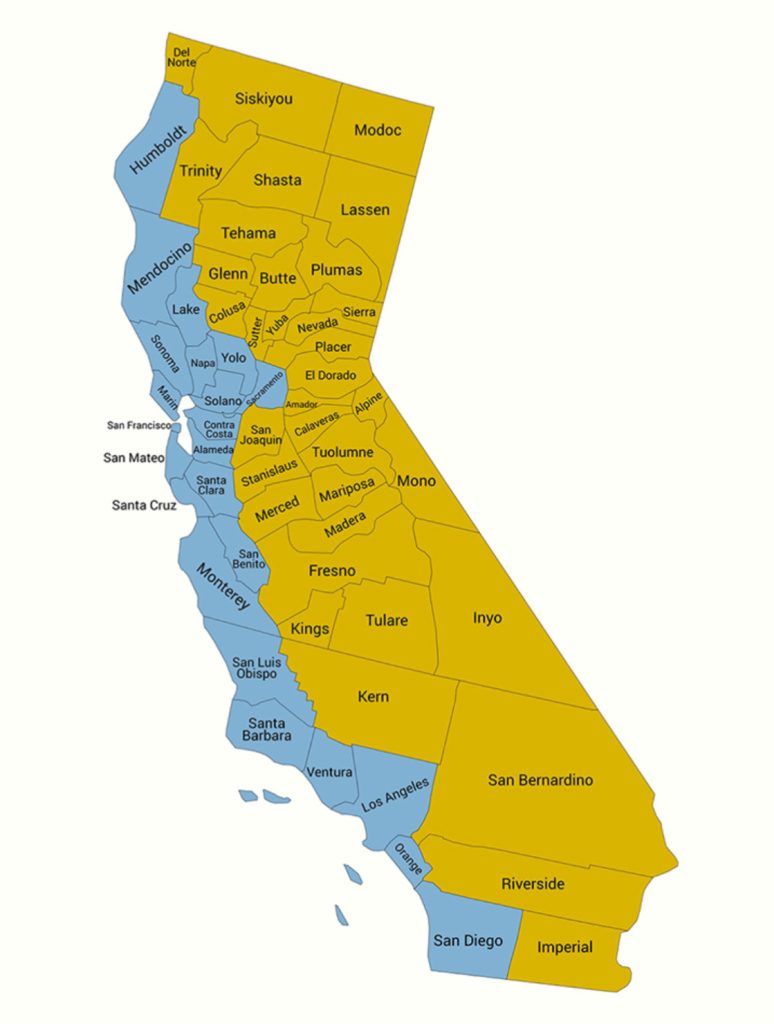
Rather than split California by north and south, as is often suggested, Gallagher’s vertical divide would create a smaller western state of 23 counties with an estimated population of 25.2 million residents. The eastern state with 35 counties would include more territory but have a much lower population of 14.3 million, according to California_Demographics.com
In the map showing how Gallagher’s resolution divides the state, Del Norte County would be the new eastern state’s only coastal county, keeping it from being landlocked.
The remaining eastern inland counties include such natural treasures as the Sierra Nevada, Cascade and Trinity mountain ranges, the Mojave Desert and the agriculturally rich Central Valley, minus Sacramento, Yolo and Solano counties.
To its advantage, the eastern side is rich in resources like water, timber, farming and hydro dams. But the new state would be burdened by a significantly smaller and less-affluent taxpayer base.
It would also lack the infrastructure and industries needed to process its wealth of natural resources, having to rely on what would become out-of-state shipping ports.
Western California, by contrast, would be blessed with its Pacific coastline, coastal mountain ranges, shipping ports, major airports, banking centers, manufacturing plants, universities and commercial industries in high-tech, entertainment and toursim.
With such a division, Western California’s government income stream would also be enlarged due to its high tax revenues coming in, especially from Silicon Valley and Bay Area counties. Considered “contributor counties,” these and other coastal counties would be relieved from subsidizing government expenses, particularly in the tax-poor eastern counties of Imperial, Inyo and Tulare.
Past attempts to split California
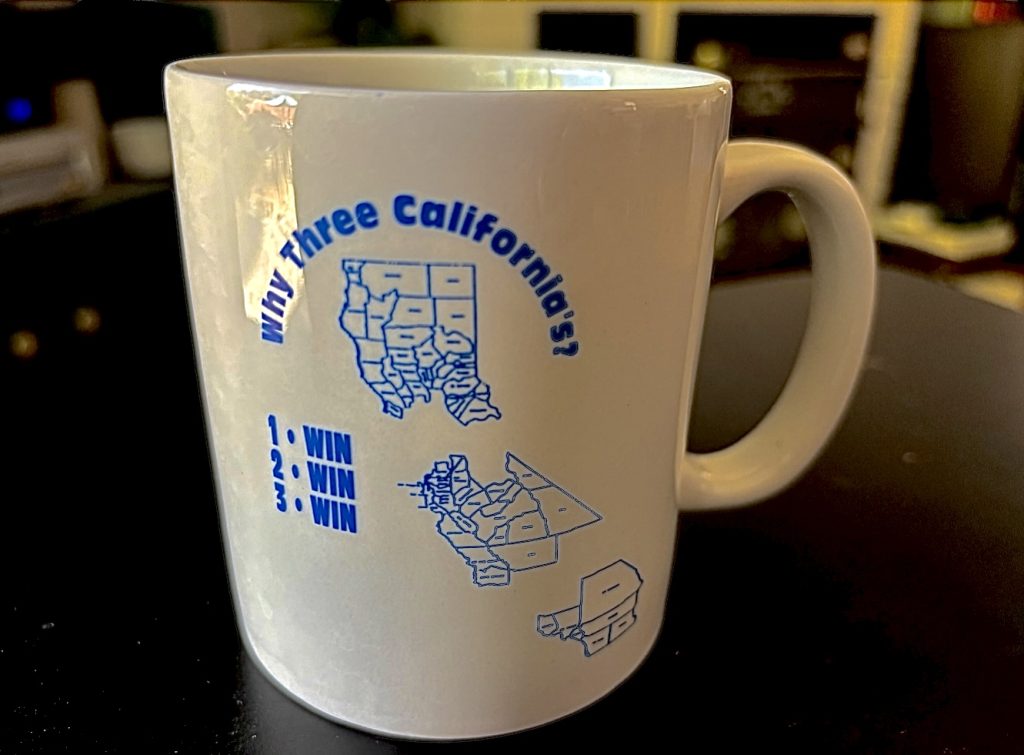
Since the 19th century, different groups have tried to divide the Golden State, with its talented and diverse population, into as many as six sections.
“That history actually pre-dates statehood, and there have been over 220 efforts to divide the state since September, 1850, when California was admitted into the Union,” noted Chico State history professor Michael Magliari. “Assemblyman Gallagher’s proposal is number 221.”
Magliari told CN&R that during the first half of California’s history, most of the efforts to divide came from underpopulated Southern California, which missed out on the wealth of the north state’s Gold Rush.
An 1859 bill by Los Angeles Assemblyman Andres Pico, which created a north/south split using the border at the north San Luis Obispo County line, passed both houses of the state legislature but died in the United States Congress.
In 1964, Republican State Senator Richard Dolwig (San Mateo) tried to cut California in half along the Tehachapi Mountain Range. His proposal passed the state senate, but died over in the Assembly.
In 1992, Assemblyman Stan Statham, who Chico residents would also remember as a longtime KHSL news anchor, suggested dividing California into north, central and southern states.
“His bill got a lot of press attention,” Magliari pointed out, “and Statham made it the centerpiece of his failed campaign for Lieutenant Governor in 1994.”
Statham was also a supporter of the “State of Jefferson” effort, which originated in the 1940s and still seeks to combine connected counties in Northern California and Southern Oregon into a 51st state.
Why we will (probably) never split up

The primary reasons why Californians will probably never get a divorce have to do with politics and logistics.
Because adding a new state would necessitate adding two new U.S. senators, many other states would see it as giving up some of their own political power in Congress.
A 2017 analysis from the California Legislative Analyst’s Office stated that legal issues to settle water rights, prison management, education funding, existing liabilities owed to retired state workers, state-issued bond guarantees and the funding transition costs would create endless court challenges, making division virtually impossible.
Magliari’s similar conclusion is that “California’s economy and economic infrastructure are too large and complex to divide easily without great financial costs and social disruption.”
Another factor to consider is that 85% of the land in a new Eastern California would still be owned and controlled by the federal government. This includes Bureau of Land Management acreage, national parks and forests, military bases, federal buildings and other holdings. Would Eastern Californians be happy owning and controlling such a small percentage of the land in their newly formed state?
“I’m sure Gallagher realizes that splitting the state is a virtual impossibility,” Magliari observed, “and that his rather unique east-west division will have no greater success than all the more familiar north-south splits have had in the past.”

Be the first to comment on "Political spectacle in Sacramento? Assembly Republican introduces 221st attempt to split California in half"