
By Casey Rafter
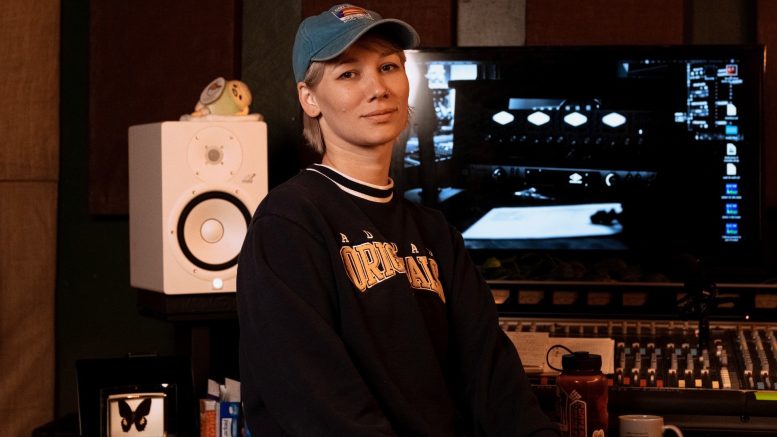
Stacked keyboards, a collection of acoustic and electric guitars, a hodgepodge of drum pieces, sound boards and a cart made heavy by three layers of effects pedals at Rosa Mortem recording studio are keeping owner Ashley Rae company as she sits inside an unassuming building in the Erikson Industrial Park neighborhood of Sacramento.
“Nobody knows this place is here, which is kind of cool,” Rae says of the space, which also holds a film studio, a workshop, a 1950s diner-styled lobby and auxiliary recording studios for both audio and video. “I am an engineer and producer. I also work in film occasionally … help people put their tours together, but it’s all industry related.”
Rae is a statistical rarity as a woman producer. In the recording industry, women audio engineers or producers only make up about 2.1% of the workforce, according to a report by USC Annenberg, which analyzed data across 700 popular songs from 2012-2018.
Within the slight margin of producers who are also female, Sacramento offers a wealth of hard working individuals who wear many hats in order to maintain momentum in their careers and help to prop up the careers of others.
The driving force
Rae not only produces sessions at her studio, but functions as owner and audio engineer, recording podcasts, voiceover sessions and studio sessions for musicians from Sacramento and beyond. Local stars Rainbow City Park, Boot Juice, Omari Tau, Hannah Jane Kylie and Band of Coyotes, as well as a handful of national talents, have all sung and played in Rae’s studio.
“I want the studio to be a full time and accessible creative space for everyone,” Rae says. “A lot of clients that I get personally are women and a lot of queer clients from a very wide variety of genres. Anytime someone asks me for a playlist of the work I’ve done, they’re like, ‘Woah. Pick a lane.’”
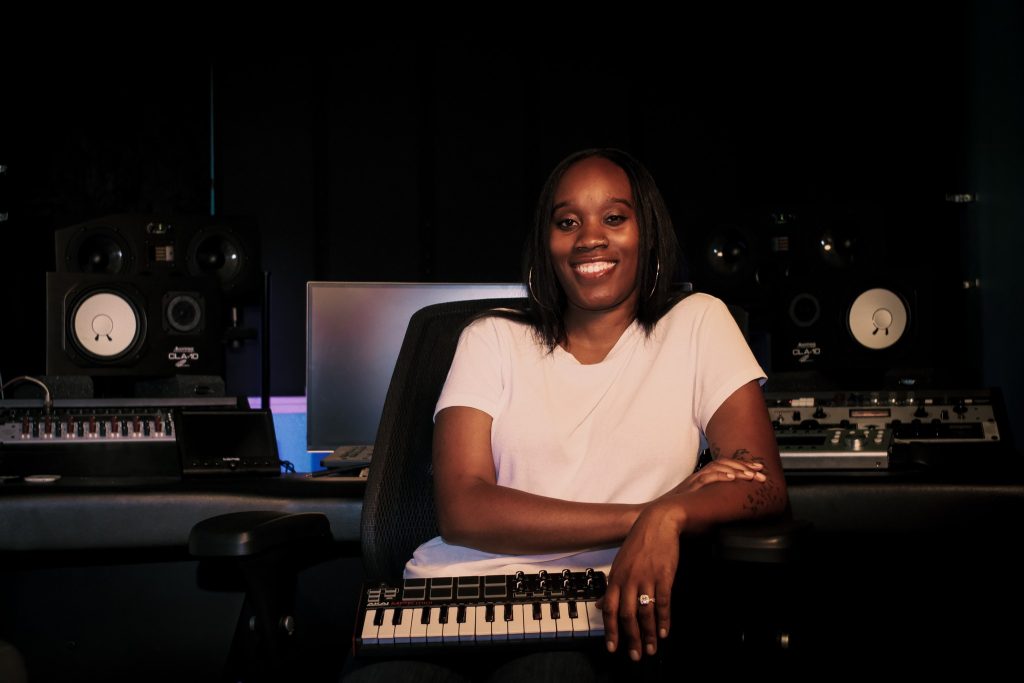
Vanessa “Ms Vame” Neves-Jackson is a music producer and recording engineer in Sacramento who champions the women who pursue a career as engineer or producer, even in the face of an industry dominated by men. She’s been a producer and engineer for 15 years, starting in the field fresh out of high school.
“There was just something about hearing the beat that I love,” Neves-Jackson says.
In the recording industry, there’s an absence of women producer and audio engineer role models for girls. The music industry has a patriarchal track record. The vast majority of widely recognized music producers are male, but this isn’t due to a lack of trying on the part of their female counterparts.
Among the most notable exceptions is Missy Elliot, who Neves-Jackson named as a huge influence on her work. She constantly keeps her eye on the industry for new women producers she might prop up or be inspired by.
“I remember listening to [Missy Elliot’s] music and just being in awe of all the sounds,” Neves-Jackson says. “I went to school for engineering and was usually only one of three women in my class. … I wish I had someone in the process, doing this during their journey, when I was on my journey.”
Locally, Los Rios Community College District offers degrees for industry training. Sacramento CIty and American River Colleges offer an associate degree in recording commercial music and Cosumnes River College has a radio, television and film production program. While Sacramento State doesn’t offer degrees in audio production, the university does offer a BA in digital film/video production with lower division coursework focused on audio production.
One of Neves-Jackson’s local heroes is broadcaster and producer Myki Angeline, who Neves-Jackson says has been a mentor in the industry for her. Angeline recently emceed Sacramento’s Gay Pride Parade and is an on-air personality at 98 Rock for Audacy, where she also helps her colleagues produce shows as needed.
“This is my first time working corporate [broadcasting] and I think I’m the fifth woman who’s been on the station in its 40-year-history,” Angeline says. “I’m the first Asian and the first queer to work there. It’s predominantly white men.”
Angeline is also a board member of G.I.R.L.S. Rock Sacramento, a nonprofit organization that provides music education to girls through instrument instruction, band forming and coaching, songwriting lessons and chances to perform publicly. Programs like G.I.R.L.S. Rock help to foster the marginalized populations of girls and women who might not otherwise have the confidence or direction to attain success in the male-dominated field.
Neves-Jackson takes the initiative she gets from Angeline and pays it forward. She says that because she’s benefited so much from her mentoring, she has taken a young Sacramento producer under her wing. She says she’s keeping the young producer from the pitfalls of the industry by instilling in her everything she’s learned on her journey.
Do you work here?
Rae says that some clients she works with have experience in other studio spaces where the environment isn’t as positive as the vibe she offers, where artists mention having been talked down to or ignored or disrespected. She says that most of the clients who report having had uncomfortable experiences with other producers have been women.
“If they don’t feel listened to or they feel ignored … that’s not how you make good art,” she says. “The vibe is everything. … If you didn’t let them try that one thing they wanted to, it’s going to be the one thing they think about.”
Rae’s studio partner is male, which she says can often lead to misconceptions of her position with new vendors and some clients. She says she’s even had international clients insist on “no women in the studio” and had to inform them that Rae is not an observer, but the engineer for that session.
“People always assume that I’m the girlfriend,” Rae says. “He always corrects them and tells them, ‘I pay her rent. It’s her studio.’ People walk right past me and he has to turn them around and tell them it’s my studio. … It blows my mind everytime.”
Rae says these are all things her partner never has to struggle with. According to her, these issues manifest in various ways: lags in receiving payment for studio time; an expectation of lower rates for her services; an expectation of additional work at no additional cost; and in some cases, tactless insistence from clients that any work be completed for them in a prompt manner. Rae says other women she knows in the industry report similar issues with clients they work with.
“I was getting these novel [length] texts of, ‘I’m going to harass you until I get what I want,’” Rae says. “Would you ever speak to anyone else like that? Other engineers told me [that client] never talked to them like that.”
Neves-Jackson echoed the same sentiment of being mistaken for the girlfriend by men in the room whenever she’d enter a studio. As a producer, she says she’s there to either show music she has or create something new and is often treated as anything other than an industry professional.
“It’s not even a thought that I could even be the producer; that’s something that I’m used to,” Neves-Jackson says. “I always go in as, ‘Hey, I’m Vanessa. I’m the producer.’ … It’s something that happens very often. I try to beat them to the punch.”
In her experience as a broadcaster, Angeline says she feels fortunate to have avoided discrimination as blatant as what engineers like Rae and Neves-Jackson have experienced.
“I have seen very little because I’ve aligned myself with organizations who are about elevating everybody,” she says. “I’m working with G.I.R.L.S. Rock Sacramento and Women’s International Music Network, but I’ve seen women being dismissed when I’m at shows.”
Angeline says she sometimes books live events here in Sacramento and once witnessed an all female three-piece band who were G.I.R.L.S. Rock veterans being treated poorly by male band members from other acts booked at that show. She says in any other scenario, one band would end their performance and have a brief pause when they could break down their equipment and the next would come up. That wasn’t the case for the three-piece at a show she says happened just two years ago.
“They were doing their show and a guy from the band playing next was standing right there on stage next to them,” Angeline says. “He was hooking up his guitar to the amp with his leg up on the stage while they’re performing … and this was an older guy in his late 50s dismissing these women like they’re not real musicians.”
The confidence to thrive
Rosa Mortem offers a unique experience in that Rae is passionate about creating a sound and a vision that other engineers may not see. She says her colleagues in the industry are often puzzled when they observe her working her magic, but there’s a method to her madness.
“My favorite thing to do is sound design. They just give me a concept and a bunch of references of vibes and I get to run wild with it,” Rae says. “They’ll be like, ‘Why are you doing that?’ and I tell them not to worry about it. Then they hear it and wonder how I got that sound. It’s trial and error.”
Despite the issue of gender disparity in the industry of studio technicians, audio engineers and producers, some opportunities come from being part of that marginalized population. Neves-Jackson says that, because of her gender and queer identity, she was offered a chance to produce two songs for “Noah’s Arc: The Movie,” a film released in June on Paramount Plus, based on the LOGO channel show of the same name. She says the placements of her music were a part of an effort that took two years to come to fruition — and because the sound designer was looking specifically for a woman of color and someone who was in the LGBTQ+ community. “I’m all three,” she says.
One of the strongest methods to counteract the challenges of finding success as a woman in a male-dominated industry is to have strong female allies with the resources to boost the trajectory of women in the industry. Sacramento has a list of strong proponents including Larisa Bryski executive director of G.I.R.L.S. Rock Sacramento and Laura Whitmore, who Angeline says helped her get a start in her career as a broadcaster in the early 2010s.
Rae is also an example Angeline gave as a supportive ally to women in Sacramento within the industry of recording, producing and engineering audio. Angeline says Rae was not only a volunteer counselor for G.I.R.L.S. Rock, but in recent years, produced songs for the organization in her studio space.
“Because [Rae] has her own studio, she produced songs for the teen camps,” Angeline says. “She was an excellent counselor because she could work easily with campers who were on the [autism] spectrum and had areas of social delicacy. She had to stop volunteering because she’s gotten stacked with artists she produces music for.”
Men aren’t always the problem, but sometimes the helpers, Angeline says. She says it’s important to acknowledge that there are also male allies that help to prop women up in the industry.
“Last year, I was on an all-female panel about women in the industry,” Angeline says. “I said, ‘Let’s cheer really loud, because you [men] are here because you’re supporting us.’ This is literally what we need, because we support men all the time. We get a lot of volunteers who are men with G.I.R.L.S. Rock. They’ve got daughters, nieces, sisters, and they’re like, ‘Yes, I’m so glad this is here.’”
This story is part of the Solving Sacramento journalism collaborative. This story was funded by the City of Sacramento’s Arts and Creative Economy Journalism Grant to Solving Sacramento. Following our journalism code of ethics, the city had no editorial influence over this story. Our partners include California Groundbreakers, Capital Public Radio, Hmong Daily News, Outword, Russian America Media, Sacramento Business Journal, Sacramento News & Review and Sacramento Observer. Sign up for our “Sac Art Pulse” newsletter here.

Be the first to comment on "Sacramento audio producers: Step aside, boys. Women are joining the club"