
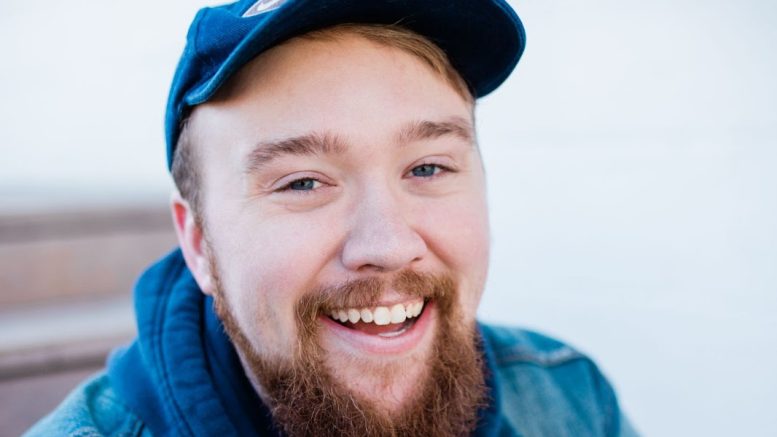
Before Beau Ryder Davis ever stepped onto a Sacramento stage, he was already deep in the storytelling world.
Growing up in Hazard, Kentucky — and later performing in places like Louisville — Davis found early success on storytelling stages, eventually becoming a nine-time Moth Story Slam Award winner. When he moved to the West Coast, he was looking for that same sense of community, and found it in events like In a Nutshell, where he performed in the very first show.
Now a Nutshell mainstay, Davis brings stories shaped by family, memory and the unique lens of Appalachian life — stories that, as he puts it, aim to make audiences feel something lasting, whether that’s laughter, reflection or everything in between.
You were part of the very first In a Nutshell show. What stands out to you about that experience?
It was really fun because I moved out here from where I’ve been living — grew up in Kentucky, lived in Virginia for a few years as I was getting my grad degree — and I had sort of been a part of the storytelling scene in Louisville, done a bunch of the Moths and stuff. So when I moved out here, I was kind of looking to see if that was, you know, something that you could see out here on the West Coast.
And I think I might have seen Keith go up at one of his first story shows that he had been invited to do, which was called Redwood Nights. And I talked to him after, and he was very excited to be like, “is this a whole thing? Is this like, a scene? Are there multiple shows like this?”
So when he called me and said he wanted to put on his own show in Sacramento, and also he wanted me to be in the first one — and also we were in this beautiful theater — I was super excited. And I remember we got a really great crowd for that first one. It was just one of those cases where it’s like, “Oh, this plan actually seems to be working,” but it was really, really special.
What keeps bringing you back to perform in Sacramento?
It’s really fun. The audience is really great… I’ve had a lot of great interactions with the Sacramento audience. The first show I did, I mentioned being from Hazard, Kentucky, and somebody you know, gave like a “Woo Hoo!” in the back and I thought, “Okay, thanks?” And after the show that person came up, and they were like, “Where’d you live in Hazard? Because I lived in Woodland Park,” and it was someone from my neighborhood, like my family knew them.
I called my family and was like, “Do you know so and so’s kid?”
People in Sacramento are very involved and very, very active listeners.
What do you think people in California misunderstand about places like Hazard, Kentucky?
I think people from my area have this really strong feeling that we were sort of disliked or despised by people in cities.
My parents would be afraid when we went to a new city; they were terrified somebody was gonna try to take advantage of us. People can hear our accents, and they know where we’re from.
There’s this cartoonish idea of what the world is, but it’s very much instilled from a young age. Hazard folk seem cartoonish to many people. So, what was really kind of refreshing and kind of sad was when I got out here, people just don’t even know about that life. People can’t even point at Kentucky on a map.
Do your stories land differently depending on where you’re performing? Do you feel like your stories about your mountain upbringing land better in California?
They resonate differently. Even when I was performing in Louisville, it felt separate enough where people would kind of be interested, almost like an outsider perspective. It’s like that on steroids out here in California
But I’ve told a lot of the stories from there, and a lot of the stories are word-for-word recited, like when we get together as a family. Most of the time, I know a story is going to work on stage because it worked in the family, and including the accent makes it more authentic.
How do you make sure the people in your stories come across as real, not caricatures?
I am always a little concerned with that. This happened at a show in Marin recently. I told a story that was … very personal, and after the show, this older woman walked up, and she was like, “What’s your mom’s name?” I said “Tracy.” She said, “Oh, that’s not right at all. She should have a name like Beulah Mae.” And I was like… “My mom’s not a cartoon character, she’s a real person.”
So sometimes I’m worried they might get the wrong idea. But you try to make sure you’re telling it in a way to humanize people.
What’s your goal when you’re telling a story?
For the most part, I’m really invested in trying to give the audience a certain experience. I just kind of want to make people laugh and want to make people generally happy. But there are stories where the emotional takeaway is sadness, and I think being able to give an audience that sort of emotional experience, I really love it.
A lot of the stories I tell about Hazard, I kind of want people to come away thinking that life can be a little magical, just like it was when we were kids, there can be meaning to things.
How do you structure a story?
Usually, a story is built around one climactic thing, so if that’s the moment, what context [do]did I need to give them? I try to think of it as exposition that ends in a big laugh; rising action, then building up to that one specific moment. Then I ask myself how to tie it all together, and that’s where I fine-tune.
The theme this month is “All You Can Eat.” What was your first thought?
It immediately went to food! I was like, “Oh I have a story I know for this exactly!” It’s one of those that’s a little funny and then a little sad and then a little funny again.
Is there a food that immediately takes you back home?
My mom’s lasagna. It’s not like a well-structured lasagna; it would just ooze, but that’s the best part. You almost have to eat it in a bowl. One time, she tried to fix her perfect recipe and was like, “I fixed it,” and the family said, “No, that’s not how we want it.” The pooling effect is absolutely necessary.
This story is part of the Solving Sacramento journalism collaborative. This story was funded by the City of Sacramento’s Arts and Creative Economy Journalism Grant to Solving Sacramento. Following our journalism code of ethics, the city had no editorial influence over this story. Our partners include California Groundbreakers, Capital Public Radio, Hmong Daily News, Outword, Russian America Media, Sacramento Business Journal, Sacramento News & Review and Sacramento Observer. Sign up for our “Sac Art Pulse” newsletter here.




Be the first to comment on "Beau Ryder makes Appalachian life feel close to home for In A Nutshell audiences"