
By Scott Thomas Anderson
They were taken in darkness.
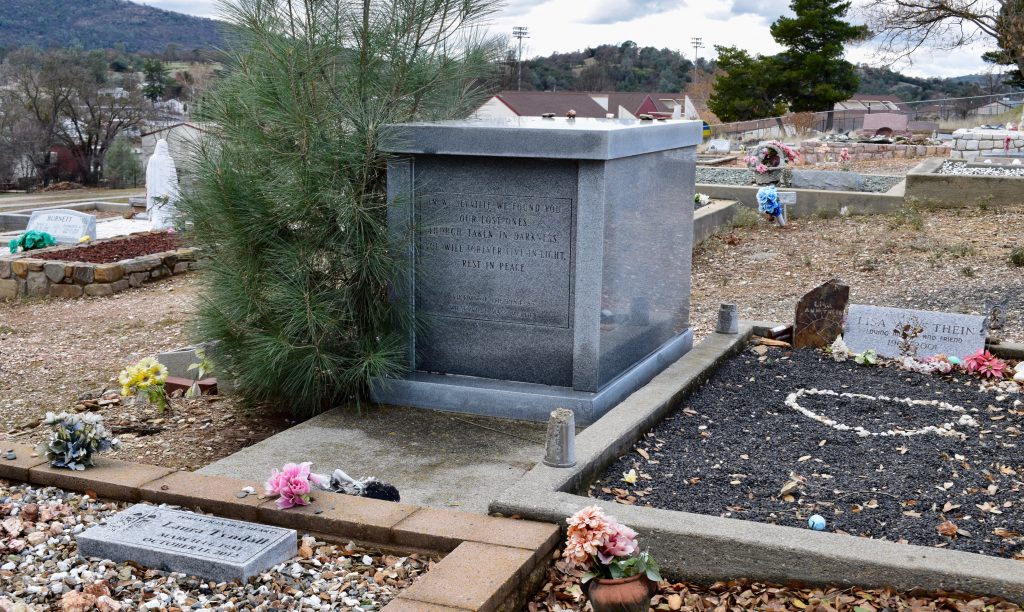
The inscription on a marble crypt in the People’s Cemetery of Calaveras County uses those words: “We found you, our lost ones, though taken in darkness …”
The ‘we’ chiseled onto its stone refers to a group of Calaveras Sheriff’s detectives and investigators from the state Department of Justice who confronted the unthinkable in1985. The ‘you’ invokes a choir of long-departed voices: Men, women and children who were kidnapped, tormented and executed on a remote mountain-scape, all to satiate two butchers determined to personify evil itself.
But the ‘you’ that’s engraved also embodies an ongoing question: In the Genesis story, God confronts Cain by saying, “The voice of your brother’s blood is crying out to me from the ground.” To this day, no one knows how many voices from the blood are crying out from inside that crypt.
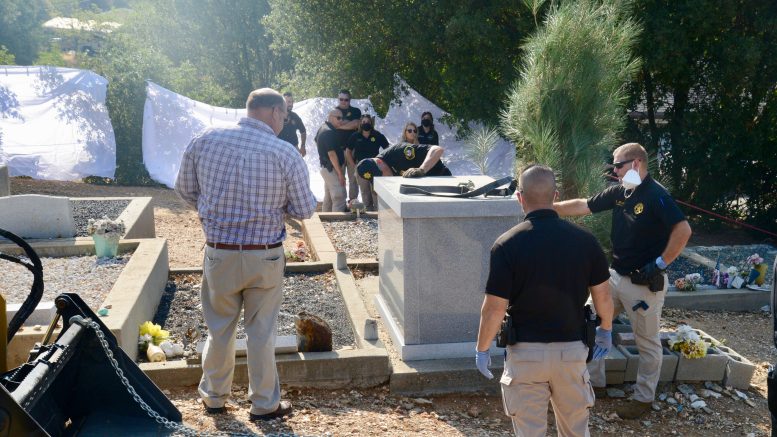
On Aug. 17, 2021, Dr. Alison Galloway – one of the most-renowned forensic anthropologists on the West Coast – stood watching as the three-and-a-half-foot high by four-and-a-half foot-long vault was opened for the first time in years. She and Calaveras detectives had arrived at a low slope of the quiet cemetery to put an end to the wondering.
Until the crypt was unsealed, however, they weren’t sure they stood a chance.
The duo serial killers Leonard Lake and Charles Ng engaged in a collective murder spree across Northern California that lasted between December of 1982 and June of 1985, with the remains of their victims buried in various states of decomposition and disarticulation around an isolated cabin in the northeast woods of Calaveras County. Back then, an exhaustive law enforcement investigation from San Francisco to the Sierra foothills ultimately identified some 19 known or likely victims of the pair. But that inquiry had been limited by the scientific capabilities of the day, meaning not all of the confirmed victims were positivity matched to remains around Lake’s rugged Wilseyville cabin. And if anything was more unsettling at the time, it was that detectives recovered burned skeletal pieces they knew might belong to people whose names hadn’t even come up in their investigation yet. It was a suspicion that proved sadly true. In the end, Calaveras and DOJ officials were forced to create a tomb of loose threads, one that was dignified and reverent – but unquestionably haunting.
Flashforward 36 years and the Calaveras Sheriff’s cold case team, with Dr. Galloway in tow, converged on the cemetery knowing that they had access to an array of new forensic technologies. Yet Galloway and the investigators weren’t exactly sure what they would find inside the crypt, or how in-tact any remains would be after the marble box endured nearly four decades of rain and snow in the oak woodlands.
The top of the crypt was carefully removed.
And then – relief.
Its interior managed to remain stormed-tight for all of those years.
“The remains were actually fairly well organized,” Galloway mentioned this month while speaking with SN&R. “They were all in plastic tubs, and within the plastic tubs were individual bags with either a single bone or small collection of bones. Everything was labeled. There were checklists with each bag.”
Calaveras Sheriff’s Sergeant Jason Waite, who was at the crypt opening with Galloway, felt a similar charge of optimism.
“It was eye-opening after the excavation,” Waite remembered, “just seeing now many materials were still available.”
The team was about to embark on an odyssey that continues to this very day.
They have cutting-edge DNA extraction techniques on their side now, coupled with the proven power of familial DNA searching methods. Yet, being based in a rural ranching community of 46,000 people, what they don’t have is a built-in budget that can truly bring those advantages to bear.
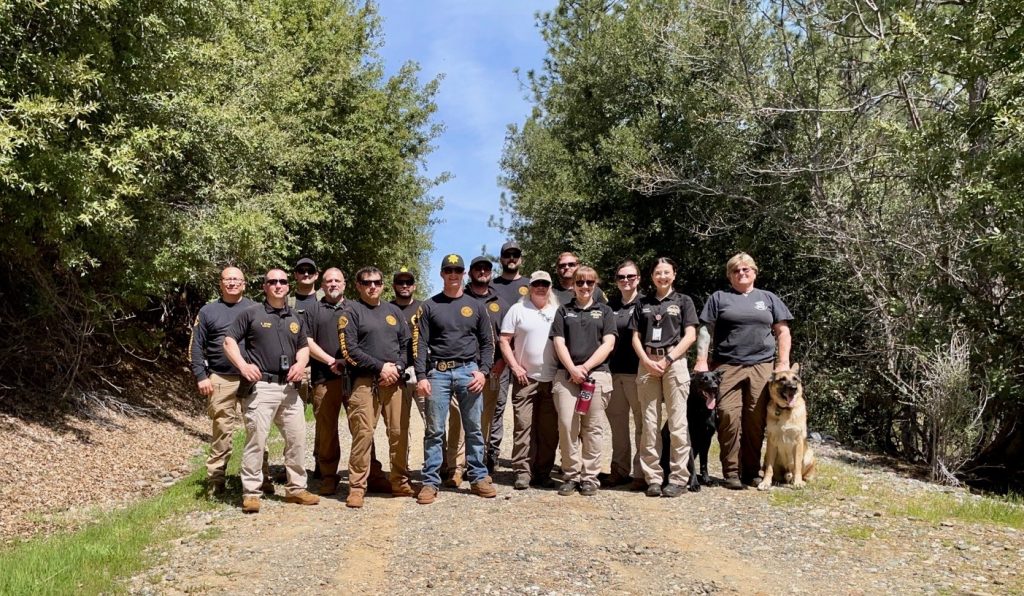
Sheriff’s Captain Tim Sturm decided the best way to move forward was, in a sense, by inviting the community to be part of the mission. His agency’s cold case team began working with members of the public on creating a nonprofit organization called the Calaveras Cold Case Task Force. The bond between its investigators and allied citizens is a shared belief that open-ended tragedies need not remain that way forever. The nonprofit has recently been hosting fundraising events and collecting donations to help pay for the use of top-tier DNA labs, as well as the best genealogical researchers available.
And so far, it’s a partnership that has paid off with two major accomplishments for victims and survivors of Leonard Lake and Charles Ng.
Buoyed by that, the task force is also mobilizing its tactics for other cold cases the area still has on the books.
“We’ve been really amazed about how receptive the community is to the team,” Sturm said.
One thing that the Captain, Waite and Galloway all agree on is that this novel assemblage in Calaveras can help people who have been distressed for years by questions of estrangement and abandonment around a loved one – parents and siblings who literally don’t know that the personality they’ve been missing for so long never made contact again because they were murdered.
“There’s a certain level of human dignity that needs to be restored, and that we, as a society, need to respect,” Dr. Galloway noted. “If you’ve had a child who’s been gone, or a brother who’s been gone, you might think they were never interested in you, or that they’ve just written you off. In some cases, these families never knew that a year after the person left, they were dead. The outcomes from this work can lift a huge weight off, and can tell families that this person wasn’t alienated from you, or angry at you, or just walking out on you. You never heard from them – but they had no choice.”
Silenced voices speak
On a sunny day in April, the remains of Brenda O’Conner lay inside a box draped in a soft, ivory covering and adorned with pink ribbons and magenta and lilac chrysanthemums. It was rolled out of the Calaveras Sheriff’s Office with those touches of care and reverence, gently wheeled along a line of deputies, detectives, task force members and elected officials who were solemnly paying their respects. Ahead of the gathering, a long white hearse waited to finally take O’Conner home.
She was arguably the most pitiful of all of Lake and Ng’s many victims. A next-door neighbor of the pair in Wilseyville, 20-year-old O’Conner lived with her partner, Lonnie Bond, and their baby, Lonnie Bond Jr., along with a family friend called Scott Stapley. After Bond Sr. and Stapley began feuding with Lake and Ng, all four people in O’Conner’s household suddenly vanished. It wasn’t long after Lake’s suicide in-custody, and Ng’s flight from justice, that investigators discovered VHS tapes from their cabin’s property: The tapes revealed that O’Conner was kept alive by the killers as a captive for an unknown period. It’s clear from the recordings that she endured all manner of enslavement and abuse, but likely none worse than the mental torture of not knowing what the killers had done with her child. The full scope and story of Lake and Ng’s crimes is covered in detail in the documentary podcast series “Trace of the Devastation,” which is written and produced by the author of this piece.
The bodies of Bond Sr. and Stapley were located in 1985, having been buried in shallow graves along an access road. But many of Lake and Ng’s other victims were burned in pyres on the cabin property. In those instances, individuals who were later recovered often went unidentified because what was left of them amounted to charred bone fragments.
“Almost everything has been burned,” Dr. Galloway said of the crypt’s contents. “And I don’t mean crispy: They were what we call calcined bone, which is where they go to that kind of grey-white, and it typically means that almost all of the organic material has been burned out of them. So, that’s a problem. We’ve had to work with the DNA experts very intensely for them to be able to extract sufficient DNA.”
For decades it was never a hundred-percent clear whether O’Conner was among the various clusters of scorched bone pieces picked out of the brush and mountain misery during that summer of ’85.
But that was about to change.
A former researcher at Tennessee’s “body farm,” Galloway is a forensic anthropologist who’s done casework around missing persons and homicides for over 40 years. She worked out of the University of Santa Cruz for most of that time, where various law enforcement agencies would bring her skeletal remains to examine. Galloway’s job was to pinpoint the size, shape and age of these bones in a way that signaled who the person was, as well as document injuries that could help a coroner or medical examiner determine a manner and cause of death. Galloway famously offered pivotal testimony in the 2004 Laci Peterson murder trial, which helped prosecutors convict the victim’s husband, Scott Peterson.
Over the years, casework from Calaveras introduced Galloway to many of its Sheriff’s deputies and detectives. After retiring to the area, the Cold Case Task Force was an ideal place for Galloway to park her talents and energy. She’s now a board member of its nonprofit and, as an expert in the field, she’s been working on the daunting crypt situation since the moment it was opened.
“We went through everything in it,” Galloway explained. “We identified what we could out of it. Sometimes it would be a finger bone or a piece of a pelvis. So, we made as many notes as we could, with as much information as we had, on each one, including whether it was a juvenile or an adult.”
Armed with local financial support, and networking with state-of-the-art forensic labs, Galloway and Calaveras detectives were finally able to determine that one cluster of bones in the crypt was, in fact, those of Brenda O’Conner.
Galloway was further relieved to know that there were enough the victim’s remains to give a small coffin-box back to her family.
Four months before, the task force had announced its first major breakthrough. They’d processed a relatively untarnished skeleton that was buried near Lake and Ng’s cabin, though it was never close to being identified. Now, sending those remains to Intermountain Forensics, a private laboratory in Utah, they were able to extract a DNA profile, which in turn opened the door to genetic genealogy searching. The task force then brought the unknown man’s information to Identifinders International, a forensic investigative genetic genealogy group.
Identifinders eventually came back to the Sheriff’s Office with a serious lead. After more investigation, detectives pinpointed the name of the anonymous victim of the serial killers – Reginald “Reggie” Frisby.
He had grown up in New York. He’s known to have moved out to San Francisco in the early 1980s. Frisby was never reported missing, nor suspected of being a homicide victim by authorities.
Frisby’s mother, who’s still alive, now understands why she never heard from her son after his move.
It was a big win for the team, but there was more work ahead.
“We have processed around 40% of the specimens that were in the crypt,” Sturm acknowledged. “But that’s deceptive because, at the time those investigators back in 1985 processed them, they might have collected, say, 20 or more pieces of bone and put them in one bag, and that one bag became a specimen … I think, in reality, we’re somewhere around 20%.”
And already another mystery has arisen from the cemetery’s sepulcher of secrets.
The task force has discovered the DNA profile of an unknown woman that Lake and Ng presumably killed. For the last 40 years, the established female victims of the pair have been Deborah Dubs, Cheryl Okoro, Kathy Allen and Brenda O’Conner. Strum says that this new DNA profile from the crypt doesn’t match any of those four women.
“She will be a new victim,” the Captain emphasized, “the same way Mr. Frisby was.”
So far, a combination of investigation, genetic phenotyping and genealogical tracing has told the task force that this shadow-woman was likely born between 1960 and 1965 and has strong family ties to Sevier Valley, Utah, through both her mother and father. Detectives also believe she may have had blue eyes, intermediate-to-dark hair, and a pale-to-intermediate skin tone. Investigators hope that anyone who had a child, brother, sister or cousin go missing from the area between Sevier Valley to Salt Lake City in the early 1980s, will contact them with that information.
“Somebody is missing her,” Sturm reflected. “You don’t just drop off the face of the Earth, as a late teen or someone in their early 20s, and nobody misses you. That doesn’t make sense.”
The girl in the water
“Time flies over us,” Nathaniel Hawthorne wrote, “but leaves its shadow behind.”
The summer of 2015 was a brain-boiler for the record books, its heat emphasizing the peak of the worst drought that California experienced in years. In the Central Valley, farming was set to lose a billion dollars and 10,000 field jobs. In Sacramento, the governor was issuing mandatory water restrictions across the entire state. In the Sierra foothills, a massive tree-die off was spreading from the slopes of El Dorado to the forests of Mariposa. And in Calaveras County, New Melones reservoir receded from a man-made lake back to its natural state as a stretch of the Stanislaus River.
It was only then that someone saw her.
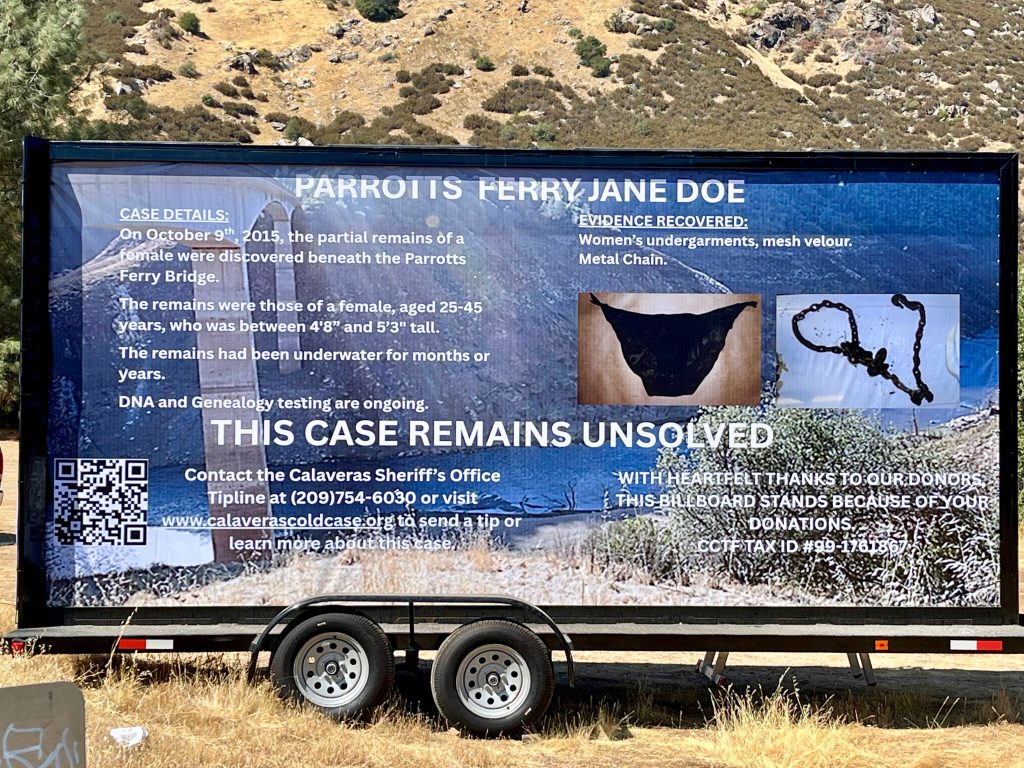
A few weeks before Halloween, a partial skeleton was spotted below the Parrots Ferry Bridge.
It was clear that the woman had been weighed down under the water by a heavy chain that was still with her. Outside of some bones, the only thing left from her very last moments was a pair of black woman’s underwear.
Homicide detectives in Calaveras worked hard to identify her that autumn. Despite canvassing the public, no one came forward with clues for establishing who she was.
Without identifying the victim, it was difficult to start looking for the person who took her life. She became a stagnant cold case, loosely referred to as ‘Parrotts Ferry Jane Doe.’
Now, Sturm, Waite and the other detectives in the task force want to give her name back.
It was trying to return this girl in the water to her loved ones that first caused Sturm and his fellow Sheriff’s commanders to decide they needed a partnership with the community. The California Department of Justice had tried to get a DNA sample from the submerged remains, but found them too degraded. The Sheriff authorized some of limited discretionary funds to pay a private lab to attempt the extraction. That wasn’t entirely successful, either, and now the agency was out of wiggle room in its budget.
“But, collectively, a few of us decided that it wasn’t going to just end there,” Sturm recalled. “We couldn’t just give up on trying to help her because of a lack of funding. That was the turning point.”
After the nonprofit component of the task force was solidified, detectives began working on the Parrots Ferry Jane Doe case again. There weren’t a lot of bones to go off of – a pelvis, a couple femurs and some vertebrae.
But all was not lost.
“There was this weird stroke of luck,” Sturm mentioned. “We wanted to measure the woman’s underwear in order to estimate her approximate size. Dr. Galloway had told us, based on the length of her femurs, we could approximate her height, but not really estimate her weight or width based on that. So, as we’re looking at that set of underwear, we could see trace hair fibers – and it was head hair that we were seeing. Probably during decomposition, the hair sloughed and became caught in her clothing at a certain point. So, we stopped right there and called the FBI. The FBI came in with their tools and evidence recovery team to assist in extracting the hair.”
Those hairs were sent to Astrea Lab in California and finally resulted in a workable DNA profile. Genealogical researchers are currently working to make Parrotts Ferry Jane Doe a Jane Doe no more. Meanwhile, the Sheriff’s office purchased some portable vinyl billboards that could be moved around on trailers and stationed in different parts of the county. They’re designed to display faces and evidentiary photographs from various cold cases for passing motorists. Sturm wants the billboards to jog memories and generate new leads. One of the first boards the team put together was for the girl in the water.
“The way that body was disregarded and discovered clearly paints a gruesome picture,” stressed Sgt. Waite, who’s optimistic about eventually being able to identify the victim.
While Waite would love to have a starting point to develop suspects in that case, he feels that reclaiming the victim’s name and story – and bringing answers to her family – should be what his team is most-focused on.
“I think back on that memorial service we had for Brenda O’Conner, and how that’s the final product of what we’re doing, and it’s incredible to me,” Waite admitted. “And in the landscape of law enforcement, where you don’t always get a lot of wins, to me, moments like that are the World Series of wins.”
Donations to the Calaveras Cold Case Task Force can be made here. Scott Thomas Anderson is also the writer and producer of the true crime podcast series “Trace of the Devastation.”

Be the first to comment on "Time’s shadow: Calaveras Sheriff’s detectives and their community find common cause in unearthing long-buried truths about cold cases in the hills"