
By Justine Chahal
Sacramento State’s Ethnic Studies department held its biannual Stop the Hate Arts and Media Showcase on Wednesday, Dec. 3, hosted in the University Union.
Originally created in May 2023, the event displays student-made art including documentaries highlighting Asian voices about specific topics or experiences. The showcase is named after the California Stop the Hate grant, created to support victims and survivors of hate and facilitate hate crime prevention services.
William Gow, an Asian American Studies adviser and assistant professor at Sacramento State, said the grant has allowed him to make his Asian American Communities course more interactive for students, as opposed to him just delivering lectures. Gow said he had the idea for the showcase during the pandemic, when hate crimes against Asian Americans were rising, increasing by 145% in the 16 largest U.S. cities in 2020 compared to 2019, according to the National Library of Medicine.
“There were … very few stories that challenged this larger narrative,” Gow said. “When I took the course over, I had this idea of tasking the students with going out and finding narratives that counter this.”
Gow said the last showcase would be the spring semester of 2026 because funding from the grant would run out that summer.
The department also collaborated with the Asian American Journalism Association’s Sacramento Chapter for the first time. AAJA is a nonprofit organization, celebrating its 40th anniversary this year, dedicated to encouraging AAPI youth to enter the field of journalism.
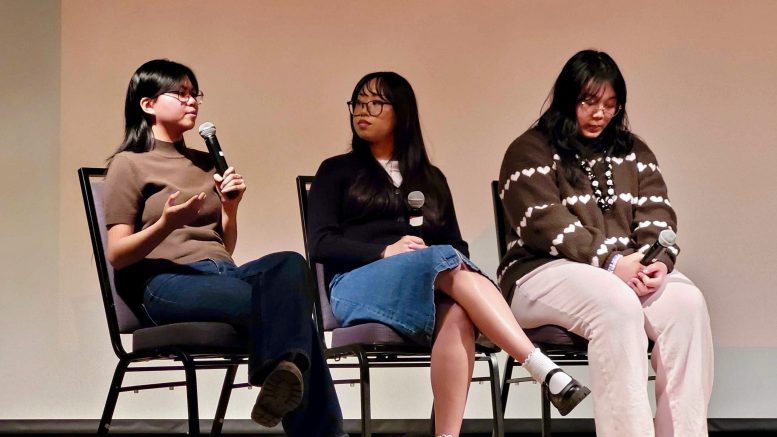
The event began with a panel led by UC Davis Health Director of News and Media Relations Pamela Wu who moderated a conversation between AAJA members Gabriel “Jack” Chin, Sharon Ito and Gaonou Vang on the importance of AAPI representation in the arts and in media.
Ito, a former reporter and news anchor for ABC 10, said when she was a journalist there were very few Asian Americans in news media and she found it important to tell stories about issues relating to her heritage. She said she believes representation allows the history to be acknowledged, rather than erased.
“I felt that it was a responsibility as an Asian American to provide context to important issues and to report on our communities, on our heritage, our shared experiences and should really let our broader community know why we mattered,” Ito said.
Vang, communications and narrative manager for grassroots organization Hmong Innovating Politics, shared a similar sentiment. She said the stories told by AAPI community members led to greater effects, including shaping policy and encouraging change, which was supported by fellow panel member Chin, a UC Davis School of Law professor.
“It starts with us leading those efforts to make sure that we are being researched, that it is being published, and unfortunately institutionalized to a level where we can be visibly seen,” Vang said. “We hold a lot of power, and with a lot of power comes a lot of responsibility. I don’t say that to burden you with this responsibility. I say that because all of us have a little bit of that responsibility, and when we can accumulate that power together, it creates a larger encouragement and movement to creating this change of narrative.”
During the showcase, student filmmakers Katelynn Lee, Annalie Saeturn and Heiley Gregorio also spoke about their experience creating documentaries highlighting AAPI voices.
Saeturn said working on her documentary “Threads of Identity: Asian Americans Fashion Journey” left a positive impact upon her, especially since she has an interest in filmmaking.
“I hope people walk away with having a sense of certainty in one’s identity and oneself after watching these films, and that after watching these videos that you feel represented and maybe empowered listening to these different stories,” Saeturn said, adding she hopes people learn about Iu Mien people. “I hope everyone gets to learn a different perspective culturally, hearing these different stories.”
Gregorio said working on the documentary made her realize she wants to pursue a career in filmmaking and just how passionate she is about film, acting and directing in general.
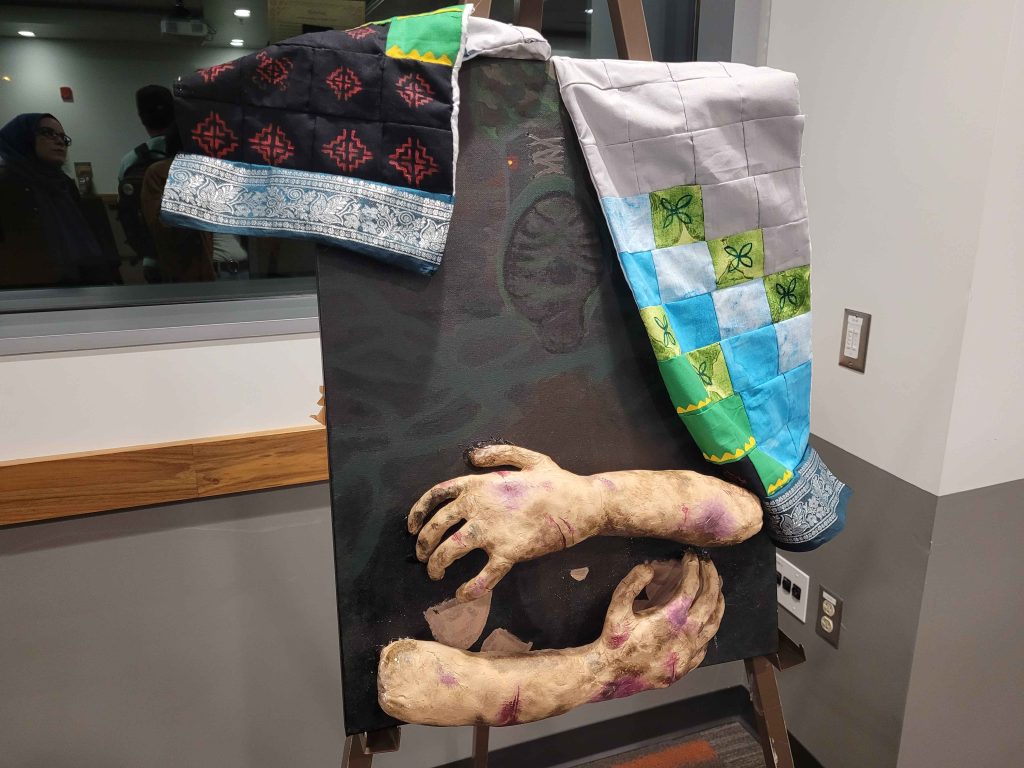
Afterward, attendees viewed an art gallery featuring student-made art, ranging in mediums from painting to collage, on the Union’s third floor as a part of the showcase’s reception.
Student Antoinette Muñoz said she liked how there were different perspectives represented t during the AAJA panel.
“I think it’s just cool that we’re able to do this and we have professors that put this together,” Muñoz said. “I think it is very important to hear about this stuff. I’m glad people from outside of my class, and community members came.”
This story is part of the Solving Sacramento journalism collaborative. Our partners include California Groundbreakers, Capital Public Radio, Hmong Daily News, Russian America Media, Sacramento Business Journal, Sacramento News & Review and Sacramento Observer. Support stories like these here, and sign up for our monthly newsletter.

Be the first to comment on "Stop the Hate showcase in Sacramento emphasizes the importance of AAPI representation in arts and media "