
By Aidan Wyrough
The lack of enough affordable housing has plagued California for decades. Can factory-built homes be at least part of the solution?
A growing number of housing advocates believe the answer is yes.
Factory-built housing, often referred to as prefab, modular or manufactured, is exactly what it sounds like — homes that are built indoors on factory sites in an assembly line setting much like cars or appliances. Advocates say an increase in the use of this model could lead to more direct and simple manufacturing processes that are cheaper than on-site construction, thus leading to more affordable housing options for consumers.
When Gavin Newsom was running for governor in 2017, he pledged a goal of building 3.5 million new homes in California by 2025, or roughly 400,00 new homes per year over those eight years. It was a goal even he called “audacious.”
It has also proven to be unrealistic. The state currently produces fewer than 110,000 units annually, total permitting has declined, and there are rising interest rates, construction costs and regulatory hurdles. The shortfall, as of 2024, was estimated at 840,000 units by Up For Growth. Others have pegged the figure as high as 2.7 million, with varying estimates in between.
With all that in mind, Assemblymember Buffy Wicks (D-Oakland), who chairs the newly-created Assembly Select Committee on Housing Construction Innovation, is exploring numerous possibilities to get more housing built statewide, including faster, cheaper ways to build homes.
In a statement on her website, Wicks said her new committee was formed to consider “exploring and advancing modern, cost-efficient, climate-smart approaches to building new homes in California.”
Enter factory-built housing.
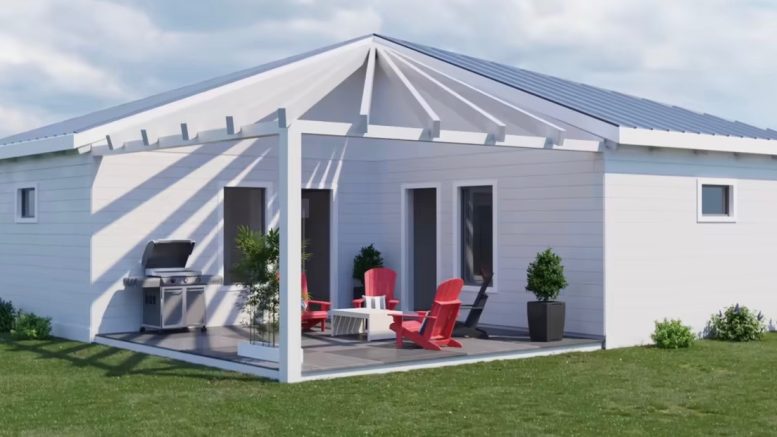
Lawmakers gave this possibility a strong nudge forward last December by approving Boxabl’s Casita model, a 2-bedroom design that doubles the living area of a previous prototype and consists of 729 square feet of living space. The model had previously been approved in Nevada as well.
In a press release, the company hailed the units perfect Accessory Dwelling Units (ADU) that are sufficiently large enough to “accommodate families, multigenerational households, or rental tenants seeking enhanced privacy and functionality.”
Boxabl CFO Martin Costas called the new units “critical” to solving California’s housing shortfall (his figure was 1.2 units).
“With housing costs burdening 66.6 million U.S. households who are consequently unable to afford $250,000 homes — and California leading the crisis — larger modular ADUs like our 2-Bedroom Casita are not just innovative — they’re essential,” Costas added.
However, Dan Dunmoyer, president and CEO of the California Building Industry Association said many concerns remain, including a lack of consistent financial backing, the promise of secure and frequent projects, and regulatory constraints, which continue to obstruct the implementation of these models.
He said investors are also worried about the lack of steady projects, noting there are often months of inactivity in the factory housing industry wherein a factory will have little to no work.
“[If] you were to tell any car company we might need some cars in January and February but not in March and April, well what do I do with my workers doing this two months? … Manufacturing any product requires a steady stream of need,” Dunmoyer said.
There are also difficulties with the costs of labor, materials and other equipment.
“Things aren’t necessarily getting built,” said Michelle Boyd, chief strategy officer at UC Berkeley’s Terner Labs. “Labor is more tight than it used to be, materials are more expensive, and we’re just seeing incredible inflation in underlying construction costs.”
Environmental review, lawsuits and housing regulations pose more challenges to factory-built projects. These regulatory complexities make it difficult to access space and hinder quick and seamless production.
Even with those existing challenges, Assemblymember Heather Hadwick, a Republican from California’s first Assembly District and member of the Select Committee, is optimistic about factory-built housing’s potential to enliven communities and combat housing shortages.
“I think it could be a huge win especially for my district. I mean, we have the timber, we have the natural resources that we need to build more houses,” she said in an interview.
“I also was pleasantly surprised that they were starting out at like $24 an hour, $25 an hour. … I think $24 to $25 would be a good competitive wage that we could actually make work in Northern California. And so I’m really hopeful.”
Boyd suggests there may also be opportunities for previously underserved communities on factory sites.
“We’ve also seen in several factories that have up to 30% women, for example,
on site. [Trades apprenticeships in California are composed of] only 4% women,
so factory work is one way to just bring a lot more people into the workforce,” she said.
Although concerns abound that factory housing may inhibit opportunities for year-round work and skilled tradesmen, Hadwick believes there can be new growth in these realms.
“Having a factory to have construction would give my folks … year-round work. … I would hope that that’s an easy sell for people,” she said. “They’re coming in and doing the electricity, the plumbing, the drywall, the patching … making sure everything’s good to go there. So there is a lot of that finished work [for skilled labor] that is still out there, and then they’re producing so much faster, so it’s more consistent and a higher quantity.”
Kyle Krause, deputy director of the Division of Codes and Standards within the Department of Housing and Community Development, testified at a Jan. 14th hearing to his belief in the distinct promise of factory-developed housing (FDH) projects.
“Manufacturing FDH on off-site [locations] allows for site work to be completed at the same time that modules are being constructed in a factory, and construction can be performed in a controlled manufacturing environment where employees and materials are protected from the elements,” he said. “These factors can reduce construction timelines, reduce material waste, and can also enhance employee safety during the construction process.”
This story is part of a six-part series called “Solving California,” a project of the Solving Sacramento journalism collaborative that explores models to improve California. Our partners include California Groundbreakers, CapRadio, Capitol Weekly, Hmong Daily News, Russian America Media, Sacramento Business Journal, Sacramento News & Review and Sacramento Observer. Support stories like these here, and sign up for our monthly newsletter.

!. There are more vacant homes in the US than the largest-since-the-great-depression homeless population. Reportedly, San Francisco has five times as many vacant homes as its homeless population.
2. Stick-built homes are pretty efficient now. The lumber arrives pre-cut, the carpenters use pneumatic hammers. Roofers take very little time to roof even a large house. Relying on factory-built homes is plausible, but not real.
3. Where is the appeal for “missing middle” affordable housing? Or mixed-income (affordable, market rate) apartments? Or residences over commerce like Citrus Heights is planning for redeveloping Sunrise Mall.