
By Rachel Leibrock
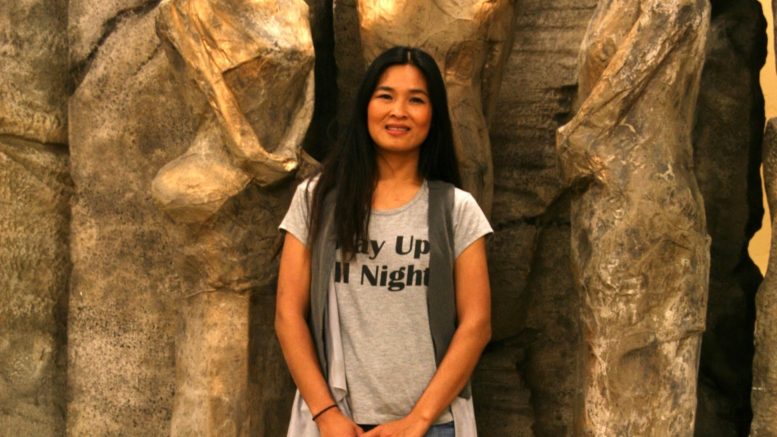
When Yennie Zhou says she doesn’t believe in talent, just hard work and skill, it’s not self-deprecation, she’s drawing on a lifetime shaped by resourcefulness and the ability to create art from almost anything, including trash.
“Everybody can design something — it’s not that hard,” Zhou explains during a recent tour of her Old Sacramento studio, Yennie Zhou Designs. “It’s like my drawings that I made when I was little — they looked so ugly, but while some people stop [practicing], I just continue.”
The compact, airy studio is located next door to Atrium, a shop that sells local goods, including a wood clock Zhou upcycled out of a discarded SMUD cable spool that once held powerlines.
Zhou’s work is an exploration of artistic reincarnation. There is an army of towering, armless “alien” women formed from recycled tomato cages, swathes of canvas drop clothes, cement and plaster. The cadre, glistening with a patina-tinged gold finish, appeared at the 2024 Sacramento Fashion Week Hair & Fashion Battle.
There are elaborate, gold headdresses crafted from plastic piping, zip ties, feathers and paper, all designed to float up around the heads of models for a Crocker Museum ArtMix event.
Outside the studio, there’s a 200-pound concrete table Zhou refashioned from another, much bigger, SMUD spool. There’s also the “Pioneer Recycle Wagon” she co-created with artists Shira Lane and JD Odbert. The sculpture was funded via a grant from Burners Without Borders, a community leadership program that’s part of the Burning Man Project. Constructed from a collection of rusty found metal pieces, including pulleys and wheels: It’s intended as a recyclables drop-off point.
While the repurposed materials may be utilitarian, the overall effect is ethereal and dramatic — and a showy study in contrast from a woman who just likes to keep her hands moving.
Zhou was born in Vietnam. In the late 1970s, her family escaped to China. Later, Zhou learned that as her family crossed the border, an elderly relative suggested her mother drown Zhou — who was an infant at the time.
“There were soldiers looking for us and they told her, ‘We can’t sacrifice everybody else because of the daughter,” Zhou says.
When she recounts the story, Zhou seems unfazed by the details or what came after. After many bureaucratic headaches, her parents relocated to California where they were able to sponsor their youngest child’s journey to the United States. Before that, however, Zhou says she essentially raised herself for a decade in a village with no electricity or running water. She spent weekdays at a boarding school and her free time drawing portraits or scavenging materials to turn into toys.
That experience, she says, shaped her artistic outlook. “There’s so much garbage everywhere,” Zhou says. “Just use it, reuse it. There’s nothing wrong with that bag or those jeans. Let’s cut everything up — it lasts for years. Make that into something that serves a different purpose.”
When she was 13, Zhou moved to California. As a teen in South Sacramento, she dreamed of being an architect, constructing homes from found materials such as dirt, bricks and even cow dung.
Eventually, Zhou pivoted to fashion, taking classes at local community colleges, where she constructed garments — one show featured a line of her dresses crafted from newspapers — and did set design for fashion shows.
Along the way, Zhou married and had two children and her work needed to evolve to accommodate parenthood. Today, she divides her time between her home and studio; a self-professed night owl, she often works into the early hours of the morning, creating props and set materials for events, including fashion shows and art installations. Lately, she’s been working as late as 2 a.m. at a nearby underground minigolf course, repairing fixtures and building props, including a set of gold mining tools.
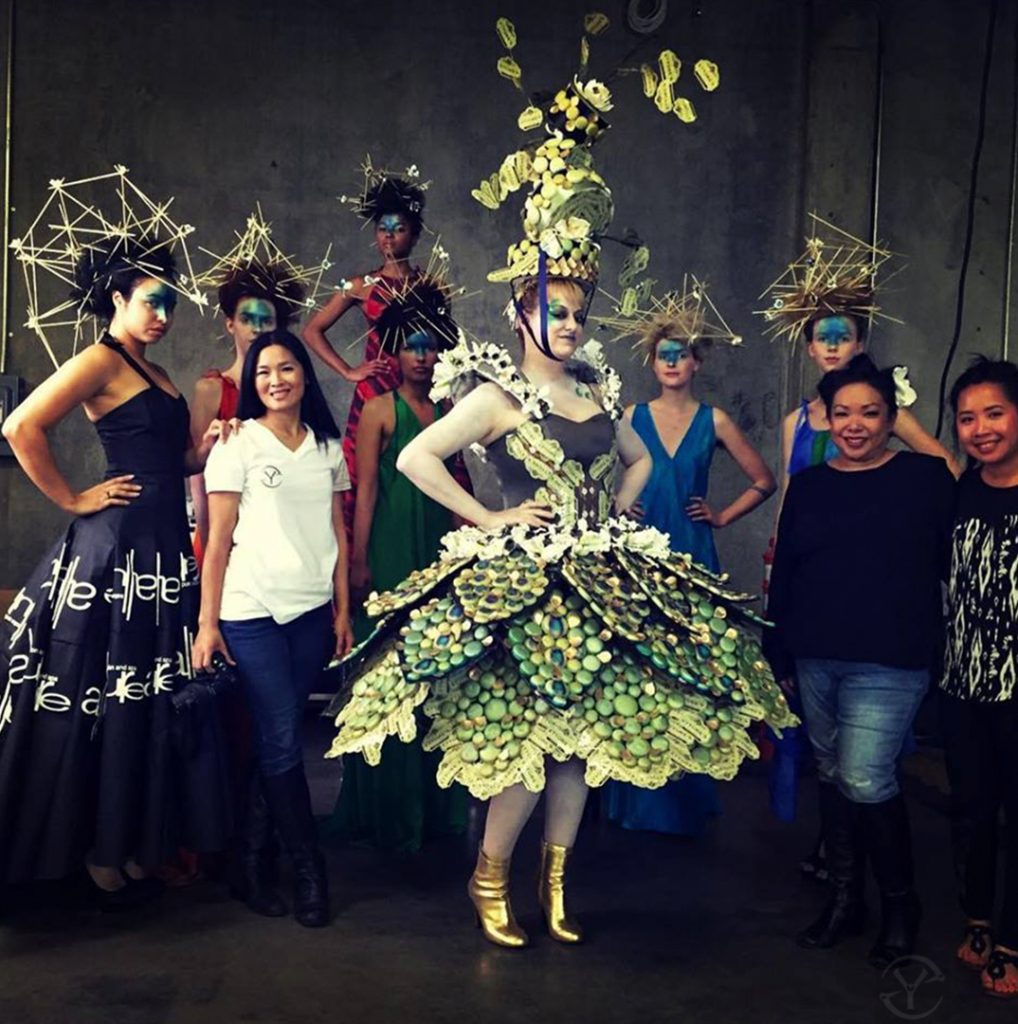
Zhou says she finds satisfaction solving design problems, often on a limited budget. While she primarily uses unconventional and recycled bits and bobs, sometimes the materials are temporary. One of her favorite projects was a dress for Sacramento Fashion Week. A local bakery sponsored Zhou so she could engineer the elaborate garment using sugar flower macaroons the bakery staff made to her specifications. Her love of architecture came in handy.
“I had to figure out the dress’s support system, the structural system, the engineering,” she says.
And was it edible? Yes, of course. “We were so tired and hungry after the show, we literally sat there and ate them with the model,” Zhou says, laughing. “I needed the sugar.”
This story was funded by the City of Sacramento’s Arts and Creative Economy Journalism Grant to Solving Sacramento. Following our journalism code of ethics and protocols, the city had no editorial influence over this story and no city official reviewed this story before it was published. Our partners include California Groundbreakers, Capital Public Radio, Outword, Russian America Media, Sacramento Business Journal, Sacramento News & Review, Sacramento Observer and Univision 19. Sign up for our “Sac Art Pulse” newsletter here.


Be the first to comment on "Yennie Zhou’s young life informs her artistic expression today as a Sacramento creative"